When it comes to commenting on political controversies, I am typically a hesitant participant. However, the current discussion around the Nigerian Vice President, Kashim Shettima, has struck a personal chord with me, compelling me to take a more active role.
Vice President Kashim Shettima has recently come under fire for his remarks about the equitable credentials of the President of the 10th Senate in Nigeria.
Shettima, a prominent northern Muslim politician, was criticized for allegedly denigrating his Muslim faith and promoting religious bias in his comments.
However, a closer examination of his statement and context reveals a different picture, one that is more nuanced and fair-minded.
Firstly, it is essential to note that Shettima’s statement was not made in a vacuum; instead, it was a response to the possibility and necessity of a southern Christian becoming the Senate President of the newly constituted 10th National Assembly. This position has become a non-negotiable right of the southern Christians, as per the default created after the 2023 presidential election.
In that context, Shettima said he would prefer a southern Christian, even if less qualified, than a northern Muslim perceived as more competent.
Of course this statement may sound controversial, but it is not without some merit.
Shettima’s point was that there should be some measure of balance and inclusiveness in the distribution of political power in Nigeria. He argued that it would be unfair for the Senate presidency, which is one of the top positions in the country – number two in the line of succession, to always go to the Christians in the South, especially as the President and his VP share the same faith.
In that sense, his statement was not meant to denigrate his Muslim faith but to promote fairness and diversity in political representation.
Moreover, it is worth noting that Shettima himself is a devout Muslim who has always respected his religion and its teachings. He has been a champion of education, healthcare, and humanitarian causes in his home state of Borno, ravaged by the Boko Haram insurgency and other forms of violence. He has also been a vocal advocate of peace, tolerance, and cooperation among different religious and ethnic groups in Nigeria. Therefore, it is improbable that someone of his calibre and stature would throw caution to the wind to make a statement that is deliberately offensive or divisive. He is too smart for that.
Some critics may argue that Shettima’s statement is still problematic because it perpetuates the notion of religious and regional quotas in politics. However, this argument misses the point that quotas are not necessarily discriminatory or unconstitutional if they promote diversity and inclusiveness and do not result in the exclusion and marginalisation of any group.
Some may argue that fairness should have been factored into the selection process for the presidential and vice-presidential flag bearers of his party. However, it is a fact that politicians are free to explore every legal avenue to win elections, including running with a ticket based on their shared faith. During campaigns, candidates are free to do what they need to do to win votes because if they lose, they bear the heavy burden of ridicule and regret alone. After the elections, the actions of the newly elected public officials are strictly guided by the laws of the land. Personal interests are no longer permitted to influence their decisions. This is when the importance of fairness and balance, in line with the nation’s diversity, is emphasised. This was precisely what the President and Vice President were prioritising during the selection process for the third and fourth highest leadership positions in the country.
In light of these facts, it is fair to say that Shettima’s statement, which is not even controversial, was not malicious or ill-intentioned. He spoke within the context of fairness and diversity, and he did not mean to harm or insult anyone. Therefore, it is important for Nigerians, especially northerners who may feel aggrieved or offended by his statement, to avoid twisting things and feigning ignorance about his good intentions.
British-American author and motivational speaker Simon Sinek once said that “feigned ignorance is a hallmark of the manipulator, and the sign of a deceiver,” even as America’s philosopher and poet TF Hodge, cautioned that “feigning ignorance may protect the ego, but it never leads to enlightenment.” The political leaders in opposition from the North should avoid promoting division or hatred by being disingenuous.
Nigerians, especially northerners, should avoid twisting Senator Shettima’s words and ignoring his good intentions. Instead, they should engage in constructive dialogue and debate the best ways to promote unity, progress, and justice in Nigeria.
Furthermore, it is essential to note that Shettima’s statement should not be seen in isolation from the broader political context of Nigeria. The country has been grappling with many challenges, including insecurity, corruption, economic inequality, and political instability. These challenges have often been exacerbated by ethnic and religious tensions, which have fueled violence and disunity. In that sense, Shettima’s call for balance and political representation should be seen as a positive step towards addressing these challenges and fostering national cohesion and development.
It is also worth noting that VP Shettima’s statement is not unique or unprecedented in Nigerian politics.
Many politicians and leaders have expressed similar views and preferences based on their interests, ideologies, and constituencies. However, what sets Shettima apart is his sincerity, integrity, and commitment to public service. He has proven himself to be a capable and compassionate leader who is dedicated to loyalty and supporting his principal, President Bola Ahmed Tinubu, in improving the lives of ordinary Nigerians, regardless of their religion, ethnicity, or social status. Nigerians, especially northerners, should give them the benefit of the doubt and avoid jumping to conclusions or making hasty judgments that promise nothing but division.
Hon Lawan expresses his gratitude to God, the Governor of Borno state, Professor Babagana Umara Zulum, party chairman Hon Ali Bukar Dalori, and his colleagues for electing him as Speaker of the Borno House of Assembly for the fourth time.
He promises to fulfill his role diligently.
When asked about his plans for the 10th Assembly, Hon Lawan mentions two critical legislative bills that he and his colleagues find essential for the state’s development.
The first bill aims to protect forests and promote afforestation to combat deforestation and desertification caused by the illicit activities of wood sellers.
The second bill focuses on preserving local culture by introducing the teaching of major local languages in primary and secondary schools in Borno state.
Hon Lawan also highlights the Borno Assembly’s contributions to the fight against Boko Haram, such as passing the law that created the Borno Youth Empowerment Scheme (BOYES) and supporting the establishment of Borno State University and other educational institutions.
Despite these efforts, Hon Lawan’s local government area, Nganzai, remains inaccessible due to Boko Haram’s presence. He urges the federal government to help restore normalcy in Nganza so that displaced residents can return to their homes and livelihoods.
Finally, Hon Lawan praises the cordial relationship between the executive and legislature, attributing it to their shared political party and the governor’s support.
Shocking news about the sad death of Chief Raymond Dokpesi has reached our news desk.
His death begins to trend on social media in the past hours.
His son, Raymond Dokpesi (Jnr) confirmed the news in a press statement he signed.
He said High Chief Raymond Aleogho Anthony Dokpesi, the Ezomo of Weppa-Wanno Kingdom, has passed away on May 29th, 2023.
The news of his demise has left many in deep sadness and with heavy hearts.
“He was a beloved husband, father, grandfather, and friend to many who will be dearly missed.”
“High Chief Dokpesi was not only a family man but a respected and accomplished businessman, a pioneer in the media industry, and a philanthropist who dedicated his life to the service of his country and community. His contributions have impacted the lives of many, and his legacy will continue to inspire future generations.
“The Dokpesi family is grateful for the outpouring of love and support they have received during this difficult time.”
The family request everyone keep them in their thoughts and prayers as they mourn the loss of their patriarch. They also ask for privacy as they grieve together as a family.
The passing of High Chief Dokpesi is a great loss to the country and the community he served. He was a man of great distinction and honor, who will be remembered as an outstanding leader and a role model for many. May his soul rest in perfect peace.
One soldier was wounded as the Troops of Sector 3 Multinational Joint Task Force (MNJTF) eliminated three Islamic State of the West African Province (ISWAP) terrorists during a clearance operation on the fringes of Lake Chad on May 28.
The injured personnel was airlifted to the Military hospital in Maiduguri for medical attention.
According to intelligence sources, the terrorists were neutralized by the troops of 86 Battalion in the fringes of Malam Fatori in Borno’s Abadam Local Government Area. Two AK-47 rifles were recovered from the terrorists after the encounter.
Zagazola Makama, a Counter-Insurgency Expert and Security Analyst in Lake Chad, confirmed the incident, stating that the troops have dealt a significant blow to the ISWAP terrorists’ nefarious activities in the region.
Insecurity in Nigeria’s Northeast region continues to worsen as reports emerge of yet another kidnapping by suspected members of the Islamic State West Africa Province (ISWAP).
On Saturday, May 27, four firewood truck drivers were abducted near Ngwom village in Mafa local government. Mafa is about 50 km east of Maiduguri, the capital of Borno state.
The drivers reportedly conveyed laborers, mostly wood fellers and loaders, to the bush when armed terrorists intercepted them.
The terrorists approached the drivers under the guise of needing their services to convey their members to a nearby village. However, the drivers and their passengers were soon taken hostage by the terrorists.
“When we tried to plead with them for mercy, one of them said we should leave immediately,” said one of the laborers, identified only as Abba.
“We were lucky because they have reviewed their policy of targeting poor laborers for kidnapping.”
However, the drivers did not return, and later two of the gunmen appeared and informed the laborers that the four drivers had been kidnapped and wouldn’t be released until each of them paid a ransom of N250,000 (about $500).
The source said the kidnapped drivers were Rawana, Isa, Ba’ana, and Bashir.
This latest incident highlights the growing threat of kidnappings by terrorist groups in the region, which has become a significant concern for the government and citizens.
ISWAP has recently turned to kidnappings of vulnerable villagers, mostly poor IDPs, for petty ransom. This enterprise runs daily and generates revenue for the terrorists.
“Families of the victims are hesitant to report to the police because they often resort to secret crowdfunding to raise the necessary ransom money. The terrorists have threatened to carry out violence if the relatives fail to deliver the money on time,” a local security source, Babangida Musa, said.
Former UK Prime Minister Sir Tony Blair has promised his support for the incoming administration of Asiwaju Bola Ahmed Tinubu during a recent visit to the Defence House in Abuja.
Blair, who founded the Tony Blair Institute for Global Change, said the organisation would be a willing partner with Tinubu’s administration in prioritising its goals and delivery.
“We would like to help in any way with your administration. We only need to know what the leadership priorities are and help in how to actualise them,” Blair told President-elect Tinubu.
In response, Tinubu expressed appreciation to Blair for the visit and for his offer to work with his administration. He spoke of the shared vision between him and the Tony Blair Institute in their priority areas, but underlined the importance of tackling investment challenges and the need for social investment to fight poverty.
“Yes, we are challenged. But where is our courage? We can eliminate ignorance, diseases, and poverty in Africa. We must work hard to ensure democracy works for our people,” Tinubu said.
“We have to invest more, put technology in place and keep terrorists at bay because without effective security, there is no guarantee investors will come,” he added.
The president-elect promised to provide a conducive environment that would encourage investors and open up opportunities for the people.
Tinubu was accompanied to the meeting by the Speaker of the House of Representatives, Hon. Femi Gbajabiamila; Vice President-elect, Senator Kashim Shettima; and other top government officials.
Other top personalities at the meeting were member of Tinubu Transition Team, Mr. Wale Edun; former Economic and Financial Crimes Commission Chairman, Mallam Nuhu Ribadu; Senator representing Lagos East Senatorial District, Adetokunbo Abiru and Executive Secretary, National Sugar Development Council, Mr. Zacch Adedeji.
Blair’s visit to Nigeria reflects the international community’s interest in the country’s political and economic development. His pledge of support to the incoming administration is a positive step towards achieving sustainable development in Nigeria.
On Tuesday, May 23, President Muhammadu Buhari authorized the resumption of oil search in Borno state, around the shores of Lake Chad.
The Nigerian National Petroleum Corporation (NNPC) Group Managing Director Mele Kyari announced the resumption of oil exploration at the Wadi B prospecting site in the Jere local government area at an elaborate event.
Wadi B is situated in Tuba village, approximately 45 kilometers away from the capital of Borno state, Maiduguri. However, the location falls within the areas still threatened by Boko Haram terrorists. To ensure the safety of officials visiting the exploration site, armed personnel escorted them while soldiers lined up the route.
The exploration of crude oil and gas on the Nigerian side of Lake Chad began in 1976 but was suspended in 1995 due to the discovery of insignificant hydrocarbon deposits.
With this resumption, the government aims to increase the country’s oil reserves and production capacity potentially.
The exploration was revisited in 2004 and carried on by successive governments until July 25, 2017, when it was suspended again after members of Boko Haram attacked a group of geologists working for the NNPC. Tuba village is located where Boko Haram terrorists have been attacking and kidnapping local farmers and wood fetchers for ransom.
According to Kyari, NNPC resumes exploration at Wadi B after thoroughly revisiting all the frontier basins using an updated approach. This approach helped them comprehend the rift system that led to successful crude oil exploration in Bauchi/Gombe states’ Kolmani area and Nasarawa state. The NNPC Group Managing Director expressed optimism that the same approach would result in the discovery of oil and gas in commercial quantities in the Lake Chad Basin.
Mele Kyari, the NNPC Group Managing Director, highlighted the use of new technologies in improving their knowledge of the geological structure of the Chad Basin.
President Buhari virtually declaring the resumption of oil prospecting at Wadi B.
He expressed confidence in the success of this exploration campaign, which would increase Nigeria’s crude oil reserves and create opportunities for the country. Kyari emphasized the significance of oil and gas in Nigeria’s prosperity and energy security, stating that they will continue to play a crucial role in the country’s energy future.
He also pointed out that the Sahara desert’s movement at half a kilometer per year puts pressure on the ecosystem, making oil and gas a significant resource for alternative energy solutions.
President Muhammadu Buhari expressed his optimism for a successful drilling campaign in the Basin, which he said will be achieved through the “collaborative efforts of NNPC Limited, the Nigerian Upstream Petroleum Regulatory Commission, the government, security agencies, and other stakeholders, including the people and government of Borno state.” His recorded speech was played at the venue.
The President congratulated the board, management, and staff of NNPC Limited for their determination and efforts towards developing the hydrocarbon potentials of Nigeria’s frontier business, leading to today’s momentous event. He also thanked the government and people of Borno state for their support and efforts towards ensuring the successful resumption of drilling campaigns in the Chad basin.
The monarch of Borno state, Abubakar Garbai Elkanemi, expressed his happiness and optimism regarding the ongoing oil exploration efforts in the region, despite the prevalent insecurity in the Lake Chad Basin. He expressed gratitude for the opportunity to explore oil, stating that it is now becoming a reality compared to the past.
Elkanemi highlighted the rich history of Borno state spanning over a thousand years, and emphasized that the discovery of oil would significantly improve the state’s statutory allocation and place it on par with other oil-rich states. Furthermore, he believes exploration could help bridge the gap in Western education and create job opportunities for your theorem, who currently face limited prospects.
Elkanemi also emphasized that the discovery of oil and gas in the state would enhance critical infrastructure, particularly roads, which have been a top priority need for the state.
Additionally, he acknowledged that the power supply, affected by regional insecurity, would be reduced when Borno became an oil-rich state.
The monarch acknowledged that insecurity is not a problem limited to Borno state alone. However, he remarked that communities in Borno are no longer under the complete control of Boko Haram, as was the case in the past. He emphasized the need to continue exploring for oil despite the security challenges and not allow them to impede progress.
Meanwhile, the state governor, Babagana Zulum, expressed a more optimistic outlook on discovering oil in the region. He confidently declared that he believes the state will become an oil-producing state before his tenure ends in 2027.
The North East Development Commission has reiterated its commitment to prioritizing staff welfare and development for improved service delivery in the Northeast region of Nigeria.
The Acting MD/CEO, Umar Abubakar Hashidu, made this known during a meeting with the Commission’s management and staff members at its headquarters in Maiduguri, the Borno state capital.
As part of the Commission’s efforts to ensure efficient processes and procedures in meeting the welfare of the people in the Northeast, the Acting MD/CEO emphasized the importance of staff welfare and development.
Acting NEDC MD and acting Chairman Addressing staff at the Commission’s HQRs in Maiduguri
He stated that a motivated workforce is crucial to achieving the Commission’s objectives. He added that all staff, both old and newly employed, need to have a sense of belonging and a sense of purpose to deliver on the mandate of rebuilding and rehabilitation of the Northeast Zone.
The Acting MD/CEO equally solicited the support and cooperation of all staff, stressing that his doors are always open for any meaningful suggestions or recommendations for the Commission to move forward.
This move is aimed at ensuring that staff have a voice in the Commission’s decision-making processes, which will help to improve their sense of belonging and motivation.
The new acting board members during a tour of NEDC facilities in Maiduguri
Acting Chairman of the NEDC, Barrister Bashir Bukar Ba’ale, while thanking the Commission’s management staff, urged them to adhere to the Civil Service rules and the Procurement Act to achieve a conducive work environment devoid of chaos.
The new acting Governing Board of the NEDC had visited the Commission’s facilities, including office accommodations and warehouses, where they interacted with staff.
It is worth noting that President Muhammadu Buhari had ordered the immediate resumption of the New Governing Board after the pioneer leadership of the Commission’s tenure expired on May 7th.
This move was aimed at preventing a vacuum in the day-to-day operations of the NEDC while awaiting the confirmation of the new board by the Senate, as stated in a press release by the Senior Special Assistant to the President on Media, Garba Shehu.
The North-East Development Commission has a new Board and management team in place, as directed by President Muhammadu Buhari to prevent a leadership vacuum that could disrupt the commission’s operations in the North-East region plagued by terror.
The tenure of the previous Board led by Maj-Gen Paul Tarfa had expired, and the President directed the new Board to assume their duties immediately.
The newly appointed Acting MD/CEO, Umar Abubakar Hashidu, expressed gratitude to President Buhari for entrusting them with the responsibility of running the commission during this critical time of recovery from the ravages of Boko Haram in the North-East.
The new Board comprises Bukar Baale as Acting Board Chairman and 10 other members of the Governing Board, including Suwaiba Idris Baba as Executive Director for Humanitarian Affairs (North East, Taraba), Musa Umar Yashi as Executive Director for Administration and Finance (North East, Bauchi), Dr Ismaila Nuhu Maksha as Executive Director for Operations (North East, Adamawa), and Umar Abubakar Hashidu as MD/CEO (North East, Gombe).
Onyeka Gospel-Tony serves as a member from the South East, while Hon. Mrs Hailmary Ogolo Aipoh is a member from the South-South region; Hon. Mrs Hailmary Ogolo Aipoh, Member, (South-South), Air Commodore Babatunde Akanbi (rtd), Member, (South West), Mustapha Ahmed Ibrahim, Member, (North West), Hadiza Maina, Member, (North Central) Alhaji Grema Ali, Member (North East) and a representative from the Federal Ministry of Finance, Budget and National Planning.
Hashidu praised the National Assembly and North-East governors for their unwavering support of the commission and promised that the new management would meet expectations when confirmed.
This change in leadership is crucial for the commission’s continued efforts to rebuild and develop the North-East region.
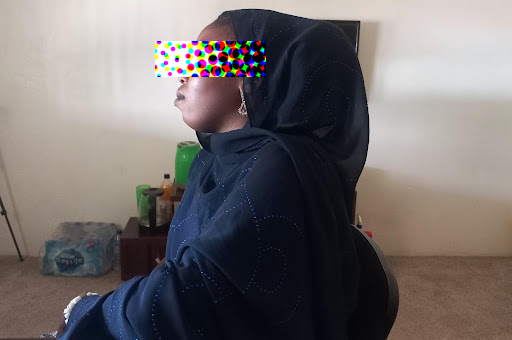
Hafsa’s harrowing experience of being abducted, abused, and forced into marriage by Boko Haram did not break her spirit. With unwavering determination, she escaped captivity, overcame stigma, and continues to fight for her future and that of her daughter.
With unwavering determination, she escaped captivity, overcame stigma, and continues to fight for her future and that of her daughter.
“He forced himself on me in the most brutal manner every night and would beat the hell out of me anytime should I dare to resist his advances for sex,” Hafsa Sale told HumAngle.
She is talking about her terrorist “husband”, the man who forced himself on her while she was a captive in the Sambisa Forest.
“It was two years of hell for me. I was bullied into remaining in that relationship with a beast who claimed to be my husband.”
Despite her traumatic experience, Hafsa Sale, 22, escaped from captivity and is now determined to move forward with her life. However, the memories of her ordeal continue to haunt her, and she fears they may never fully fade away.
Wearing a solemn expression, Hafsa, who is from Borno State, northeast Nigeria recounted the horrific abuse she suffered at the hands of Boko Haram militants during her two-year captivity in the Sambisa forest.
Journey interrupted
In November 2019, Hafsa had attended a family funeral in Kaduna. The journey back to Maiduguri in Borno state, was long and tiring.
The car journey was about to be interrupted at a village called Ngamdu, 100 km short of her destination.
As they approached Ngamdu, the driver had to slow down due to a rough patch of road, and that was when they saw the armed men. The driver attempted to speed through the group standing by the roadside, but the gunmen opened fire.
“Our vehicle nearly skidded off the highway as a bullet hit the driver in the head,” Hafsa narrated. “I don’t know how the car managed to stop because the driver, whose head was blown off, was already dead.”
The assailants dragged the driver’s body out of the car and left it by the roadside. One took over the wheel and drove the vehicle into the bush, while the others followed on their motorcycle. Hafsa was left traumatised by the harrowing experience, highlighting the ongoing security challenges many people face in Nigeria.
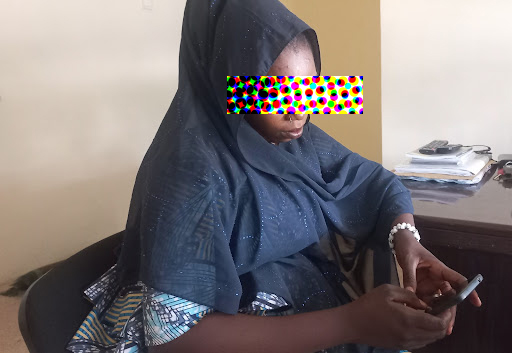
Hafsa checks her daughter’s photo on her mobile phone. Photo credit: Abdulkareem/HumAngle
After four days of travel, they finally arrived at Sambisa and were confined to a house by their captors. The kidnappers demanded that they provide phone numbers of their relatives and friends back home, promising to call them and request ₦2 million each in exchange for their release.
“They made it clear to us that any involvement of security operatives would result in severe consequences,” she recalled.
Police ambush
Initially, the victims believed that the kidnappers were just ordinary criminals. Some women even made the calls and got the money.
One of the women’s husbands was a police officer who then informed his colleagues about their situation.
The police secretly went with the people who had the ransom money to where they were supposed to meet the terrorists. When the kidnappers let the hostages go and took the money, the police shot at them and killed many. They also got back the money and the motorcycles that belonged to the kidnappers.
Back at the camp, Hafsa had assumed the role of guardian for the children. “I was the oldest person left,” she said.
However, one day, the Boko Haram terrorists dragged out the most senior boy, Kamala, and brutally murdered him in front of the captives.
“His crime was that he refused to convince his siblings to accept the Boko Haram ideology,” Hafsa explained.
After the police ambush, some of the surviving terrorists began to blame Hafsa for the deaths of their colleagues.
“So, they began to whip me every day until they got tired after some days,” she recounted.
“Should I pull off my dress?” she asked HumAngle. “You could still see the deep scars of the whipping on my back.”
Sadly, the boys left Hafsa’s custody and soon became radicalised. They joined Boko Haram as fighters.
“The boys, whom I cooked food for daily, began to threaten my life because I was unwilling to accept the Boko Haram creed,” she continued.
One day, they came to her hut and threatened to kill her if she refused to marry one of their commanders.
“I saw the devil in their eyes, and I had no option but to succumb to the marriage,” she said in tears.
The abuse
The Boko Haram commander Hafsa was forced to marry was known as Abu-Hanif.
“Months into the marriage, I became pregnant but later had a miscarriage due to Abu-Hanif’s violent behaviour,” she said. “Despite my condition, he continued to engage me in forced sexual intercourse until I became pregnant with my daughter.”
After giving birth, Hafsa attempted to escape one night during a rainstorm when the men had gone out to fight.
She ran until she reached one of their checkpoints, where some of the terrorists were on guard. They caught her and forced her back.
“They shackled my legs and left my baby and me in the house,” she said.
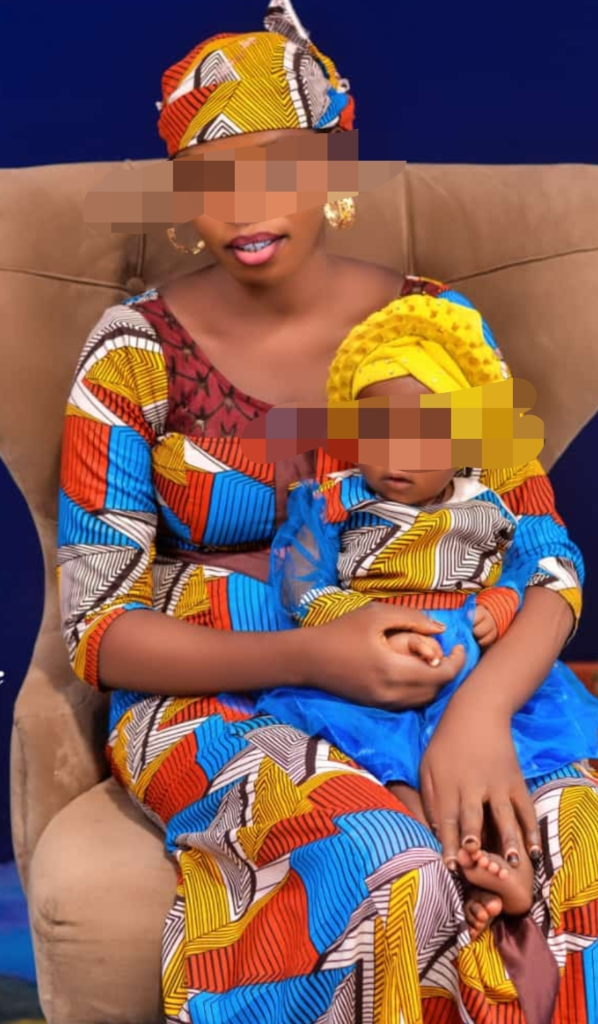
Hafsa and her daughter, Maryam, during a recent Eid celebration. Photo Credit: Hafsa Sale
Bound in chains, Hafsa suffered captivity for three long months until she finally found the courage to break free and attempt another escape. Before her second attempt, she managed to gather valuable information about potential escape routes from friendly and unsuspecting members of Boko Haram whom she had worked to build a rapport with.
Despite the immense risk involved in her plan, Hafsa’s determination to regain her freedom pushed her to take the necessary steps toward a successful escape. She knew the road ahead would be tough, but armed with the knowledge she had gathered and fueled by a fierce desire for freedom, she set out.
“They informed me that there were three potential routes leading out of Sambisa from our current location,” she recalled.
“The first route led to Bama, the second led to Gwoza, and the third, which was undoubtedly the easiest, led to Pulka village.”
One fateful night, Hafsa took the route to Pulka with her child strapped to her back. The journey was tough, taking them nearly four days to reach the village’s outskirts.
“As we approached, I had to remain vigilant, hiding whenever possible to avoid detection,” she said.
Farmers working in the area spotted her, and they immediately alerted the nearby military post upon seeing her. She later learned they were suspicious because she was holding something under her hijab. That something was her baby.
So the soldiers were apprehensive when they approached her, fearing she might be a female suicide bomber. It took some time for her to convince them that she had just escaped from Sambisa forest and what she had under her clothes was her child.
“Despite her explanations, the soldiers remained sceptical and demanded that she prove her innocence.
“I was forced to strip naked to confirm that I was not an enemy combatant. The soldiers were eventually satisfied that I posed no threat, but the incident left me traumatised and deeply shaken because they were all pointing their guns at me.”
The soldiers took mother and daughter to the Pulka IDP camp, where they were provided with warm water to bathe and food to eat.
“Eventually, we were relocated to Bama, where I could recharge my mobile phone, which I kept hidden in my travel box or sometimes under my brazier.”
Hafsa said she treasured that phone because she hoped she would one day escape and use it to call her relatives.
“The phone’s battery had died, but luckily, boys in Bama offered to charge phones for a fee. They boosted my phone’s battery, and I was overjoyed to call and speak to my dear mother.”
The experience of being able to speak with her family after months of captivity was emotional and overwhelming.
“It was a reminder that I was not alone in my struggles and that my loved ones were still waiting and hoping for my safe return,” she said.
Living with Abu-Hanif
Hafsa recounted that the man who fathered her daughter was cruel and abusive. He had no compassion or sympathy towards her and had subjected her to constant physical and emotional abuse during their time together. She could only recall a few instances where he had spared her from his violent outbursts.
Sometimes he withheld food from her for not adhering to his religious beliefs. And then, when it came to sexual intercourse, he showed no regard for her feelings and would often resort to physical violence before forcing himself upon her. Tragically, Hafsa lost her first pregnancy at just four months due to the abuse she endured.
According to Hafsa, the terrorist-husband frequently referred to her as an infidel and treated her with unspeakable cruelty, as if she were subhuman.
When she eventually made it to Bama, Hafsa came in contact with other women who had also fled from Sambisa. They informed her that the man responsible for her suffering, Abu Hanif, had died during the last operation they had gone on before Hafsa’s escape.
Some months before she left, the group had split into factions. Her former tormentor had been with those who broke away and formed the Islamic State of West African Province.
The news relieved Hafsa, but the trauma of her past experiences continued to haunt her. She was determined to move forward and reclaim her life, but the scars of her past would remain with her for years to come.
“I was delighted to hear that he was killed in a fight with a rival group of Boko Haram. He was on the side of ISWAP,” she said.
“I am happy that he is not alive or among those who are surrendering today in Maiduguri. His being alive would have tormented me for life.”
Hafsa recalled that in Sambisa, the cost of paying the bride price and conducting a brief wedding ceremony at the mosque to consummate the marriage is only ₦3000 (about $6). She explained that Boko Haram considers elaborate wedding ceremonies and fanfare sinful.
“To avoid drawing attention, marriages are conducted quietly, with only the men congratulating the groom after the dowry is paid,” Hafsa said.
In the evening, two or three older wives of Boko Haram leaders would accompany the “bride” to her home – a mud house covered with bare corrugated iron sheets, mainly under trees to evade detection by military aircraft.
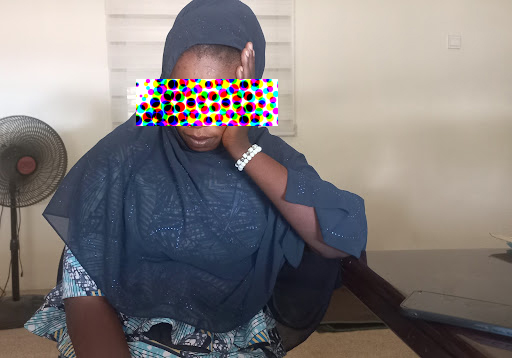
Hafsa says she is determined to give her all to her child. Photo credit: Abdulkareem/HumAngle
Returning home with a child
Hafsa had to plead with the camp officials to let her go home and see her family after spending weeks at the Hajj Camp rehabilitation centre. Initially, the officials did not believe she had a family in Maiduguri until her brother came to the camp to confirm her story.
Once she was allowed to go home, her friendly nature drew many visitors and supporters to their house. However, upon seeing her physical and health condition, many of them broke down and cried.
Shortly after, Hafsa fell ill and was hospitalised for several days. The doctors had to administer four pints of blood before she could recover from the strange ailment that had befallen her. Throughout her illness, Hafsa was terrified about her daughter’s fate should she die.
But after Hafsa’s recovery came another challenge – handling stigmatisation outside her home. She had to learn to stand up when anyone tries to denigrate her or mock her daughter. She also constantly reminded herself that she was not responsible for what befell her because anyone could be a victim.
“I am a fierce survivor, and I even had to fight the wives of Boko Haram who dared to come and mock me in Sambisa. Yes, out there, I was wild and fearless, and I even beat up two women who called me an infidel,” she said.
Although this later earned her a severe beating for daring to fight the wife of one of their commanders, Hafsa eventually earned their respect. “They avoided causing me trouble after that, and I could live peacefully.”
Moving on
Hafsa said she is no longer ashamed of her circumstances and is not afraid to confront anyone who tries to say anything nasty.
“I’ve told them that I will not be apologetic about what happened to me because they, too, are not immune to being a victim.”
She added: “I hate and detest the man who fathered my daughter, but my daughter is my world. I am determined to bring her up as a proud, confident, and happy child.”
At the moment, Hafsa lives in a neighbourhood where people lack education on trauma and dealing with survivors of armed violence. Her mother and childhood friend have been her primary source of support. Her friend takes care of her daughter and never gives up on her. This and more has kept her away from mental illness.
One other significant part of the support system is the constant love she gets from her boyfriend, who remained dedicated after her return. He eventually proposed marriage, and although Hafsah hesitated due to her past, she later agreed.
Since her return home in Nov. 2021, Hafsa has focused on taking care of her child. Having lost contact with her for many months, Hafsa’s family had given up on ever seeing her again, leading them to give away most of her personal belongings, including her school credentials. She had seven credits in her West African Examination Council (WAEC) result.
Before her abduction, she had planned to pursue her dream of becoming a nurse by enrolling in the College of Nursing and Midwifery. Despite this setback, Hafsa intends to work and provide for her daughter until she can afford to return to school.
Lifeline
Hafsa was recently supported by a Maiduguri-based NGO, Allamin Foundation, to learn how to produce liquid soap, petroleum jelly, room fresheners, and toilet disinfectants. After completing the two-week skill acquisition programme and receiving a starter pack from the NGO, she started a successful business.
She expressed gratitude to the foundation, stating that the business skill she gained will help her save for her daughter’s education.
“Besides my family’s moral support, I have not received any empowering support from anyone. With my mother getting older and our father passing away years ago, I am a single mother with no one to rely on. However, the newfound skill I have acquired has made me independent and empowered,” she said.
Hafsa has since been making brisk sales promoting locally-made detergents and room fresheners on her social media handles. People patronise her products, mainly through her WhatsApp profile page, where she often posts photographs. She also delivers her products to retail shops at discounted rates to help them make a quick profit.
When Hafsah is not running her own business, she works shifts as a fuel pump attendant at a local filling station near her home.
This breathtaking piece of journalism was published initially by HumAngle


 Bay States News