
By Abdulkareem Haruna
Back in September 2009, many Nigerians, particularly Muslims, were left astounded when a man contradicted the date declared by the Sultanate of Sokoto for observing the end of Ramadan moon – and the man’s alternative prediction turned out to be correct.
The man in question was none other than Mr Salisu Zubairu, who was convinced that the 2009 edition of Ramadan would last for 29 days instead of the previously announced 30 days by the country’s Supreme Council on Islamic Affairs. And true to his word, that was exactly what happened.
While the Supreme Council on Islamic Affairs probably relied on human judgment, Mr Zubairu relied on science. He used the calculations from his revolutionary telescopic invention, the ‘4x60mm Zubairu Calibrated Telescope,’ to accurately predict the end of Ramadan.
Mr Zubairu’s groundbreaking invention offered a fresh perspective on traditional methods that relied on human judgment, which could sometimes be susceptible to errors. His use of science and technology showed how a well-calibrated instrument could provide more reliable and accurate results.
Mr Zubairu’s achievement highlighted the importance of using science and technology to complement traditional methods to achieve greater accuracy and precision in various fields. His contribution to the scientific community will undoubtedly inspire future generations of scientists and innovators in Nigeria and beyond.
Although Mr Zubairu’s counter-views to the Sultanate’s declarations were offensive to many good Muslims who revered the Sultanate, they were unaware of the extensive research and development he had conducted over many years. He used his technology to arrive at authoritative conclusions that challenged traditional observation methods.

Mr Zubairu’s ‘4x60mm Zubairu Calibrated Telescope’ was instrumental in fabricating a rare kind of Lunar Tracking Clocks that he used to prove that one full circle of the lunar movement against the Gregorian calendar completes in 33 years. His findings were original and groundbreaking.
Explaining his discovery, Mr Zubairu said, “I was able to discover perfectly that in 33 years, the days of the lunar movement Mrifted gradually and returned to where it started.”
While Mr Zubairu’s findings were met with scepticism at first, his groundbreaking research and technological advancements proved to be a turning point in the way lunar movements were observed and predicted. His discovery has paved the way for more accurate and reliable predictions of lunar movements. It has inspired a new generation of scientists to explore the possibilities of using technology to complement traditional observation methods.
Mr Zubairu’s discovery has significant implications for the study of lunar movements. He says, “This discovery signifies that the lunar movement against the earth, even if they scatter in their trajectory, always returns to the same position after 33 years. I’ve gotten so many findings in my research on the lunar movements, which are novel and original. And this has never been researched anywhere in the world.”
Mr Zubairu’s groundbreaking research on lunar movements has revealed a harmonic Mrift in lunar dates against the Gregorian calendar. His findings challenge traditional observation methods and have paved the way for more accurate and reliable predictions of lunar movements.
The technologist’s work has been recognised internationally. He explained, “I sent my findings to an international journal for a review, which came back as original work; ‘no recent work was sighted at that time’.”
His research and technological advancements have transformed how lunar movements are observed and predicted. His discovery has inspired a new generation of scientists to explore the possibilities of using technology to complement traditional observation methods. His contribution to the scientific community will undoubtedly have a lasting impact.
Mr Zubairu Salihu, a multi-talented Nigerian scientist and technologist from Adamawa state, has made significant contributions to the field of lunar telescopy. Based at the University of Maiduguri, he discovered a discrepancy between the lunar and Gregorian calendars that causes the lunar calendar to Mrift over time. This discrepancy, known as harmonic Mrift, has important implications for the Islamic calendar, particularly for the timing of Ramadan.
Mr Zubairu is a senior technician at the Physics Department and an active researcher who has published several papers in international scientific journals. His work on the lunar calendar has garnered widespread attention and media coverage.
His groundbreaking research has shed light on the discrepancies in the lunar calendar and has paved the way for more accurate predictions of lunar movements. His contributions to the scientific community have been invaluable. He explained, “I have always been passionate about science and technology, and I am glad that my work on the lunar calendar has been recognised internationally.”
Mr Zubairu’s achievements have inspired a new generation of scientists and technologists in Nigeria and beyond, and his legacy will undoubtedly have a lasting impact on the field of lunar telescopy.
The Islamic calendar is a lunar calendar that relies on the moon’s cycles to determine religious observances. However, because the lunar month is shorter than the solar month, the Islamic calendar doesn’t align with the Gregorian calendar. To address this difference, the Umm al-Qura calendar uses astronomical calculations instead of actual moon sightings and is utilised by the Saudi Arabian government to determine Islamic holiday dates.
Despite the Umm al-Qura calendar’s use of astronomical calculations, it still experiences some drift over time. Mr Salihu’s research reveals a secondary Mrift in the lunar calendar caused by the harmonic interaction between the moon and the Earth. Although smaller than the primary Mrift, the secondary Mrift is still significant over extended periods.
Mr Zubairu’s discovery has significant implications for the Islamic calendar, particularly in determining the timing of Ramadan, the month of fasting in Islam, determined by the sighting of the new moon. Because the lunar and solar calendars do not align, the start of Ramadan can vary up to two days annually, causing confusion and uncertainty for Muslims worldwide who rely on the lunar calendar to determine religious ritual timing.
The UNIMAID wizkid’s research on harmonic drift offers a potential solution to the problem of the lunar calendar’s drift. By accounting for the secondary drift, it is possible to evaluate the lunar calendar using a scientific approach. This involves determining the possible first lunar location above the western horizon approximately 30 minutes after sunset, which is the reference location and time.
Mr Zubairu’s recently published research, “Scientific Observation of Harmonic Drift in Lunar Dates Against Gregorian Calendar,” available on Amazon, reveals that existing lunar calendars are primarily based on numerical differences resulting from the discrepancy between the Islamic and Gregorian calendars. Mr Zubairu’s work on harmonic Drift provides a more accurate and scientific approach to evaluating the lunar calendar.
In the published project, Zubairu, an Ophthalmic Optics graduate from Temple University Philadelphia, emphasized that the “Harmonic Drift in lunar dates against the Gregorian calendar is noticed as a secondary Drift and possible cause of the discrepancy in the lunar calendar.”
In his published project, Zunairu, a graduate of Temple University Philadelphia in Ophthalmic Optics, highlights the importance of the “harmonic Drift in lunar dates against the Gregorian calendar.” This secondary Drift is a possible cause of the discrepancy in the lunar calendar. It has aided in developing a more reliable lunar calendar capable of projecting dates for extended periods without differences.
Zubairu hopes his published work will excite individuals and organisations interested in astronomy, including educational institutions and research centres.
Who Is Mr Zubairu Salisu?
The 65-year-old technologist, Zubairu uniquely understands the harmonic Drift in the lunar first-of-its-kind Gregorian Calendar. However, this is not his first discovery. He has also fabricated binoculars, sniper lenses, a first-of-its-kind lunar-tracking clock, and a space observatory using locally sourced materials. Zubairu’s expertise in lunar reading has made him Nigeria’s walking encyclopedia in lunar tracking. He has multiple talents that go beyond his original field of Ophthalmic Optics, including manufacturing various lenses for military and space-related viewing.
In 1988, Zubairu, then 29 years old, gained recognition for creating binoculars using locally sourced materials. The Federal Ministry of Science took notice and invited him to present before a presidential brain Drain committee on science. Journalist Nosa Igiebor wrote about Zubairu’s invention in the May 1988 edition of Newswatch magazine, stating that he “has made a pair of binoculars, magnifying glasses, a convex mirror and a microscope. And now Zubairu has designed an astronomical telescope. But then he did not have the facilities to make the device.” Despite his achievements, Zubairu could not obtain financial backing or sponsorship from the Nigerian government to pursue his Dream.
“I have visited the Project Development Agency (PRODA), Enugu, and the Federal Ministry of Science and Technology. But they kept asking me to come back again,” said Mr Zubairu, according to the Newswatch magazine. Following the publication, Zubairu was invited to present his work at the Federal Ministry of Science and Technology. He met Professor Madu Mezia, a renowned physics professor and Special Assistant to the then Minister of Science and Technology, Emmanuel Imovon. During the Babangida regime, Zubairu could attend meetings with Professor Alele Williams as part of a federal government science committee named ‘the presidential Brain Drain Committee.’
Zubairu presented his work before the committee and impressed everyone in attendance. Professor Awele Madu Mezia was particularly impressed and shortlisted him to be a member of the Sheda Science Village in Kwali, Abuja, where indigenous scientists and inventors develop their skills. However, Zubairu did not receive an official letter to report to the centre because it lacked equipment for optical science and instead only invited talents in engineering.
“I was among the first list of persons to be shortlisted to be at Sheda Science Complex, from where we were supposed to travel to Germany for some training. But unfortunately, I did not get the official invite; so others went to Germany, and I was never called again.
The Nigerian government failed to support Zubairu’s skills even after 35 years since he created these scientific tools, which Nigeria still imports from abroad. Zubairu, now 65, believes it is not too late for the government to support his project, but he also worries about time running out.
Zubairu currently works as a Lead Technologist at the Department of Physics at the University of Maiduguri. He obtained his first degree in Ophthalmic Optics from Temple University in Philadelphia and returned to Nigeria in the early ’80s to work at Isijola Optical Service in Lagos. In 1992, he declined an offer to work as a lead Ophthalmic Optician at the University of Maiduguri Teaching Hospital. Instead, he was appointed as a Lead technologist in the physics department at the same university.
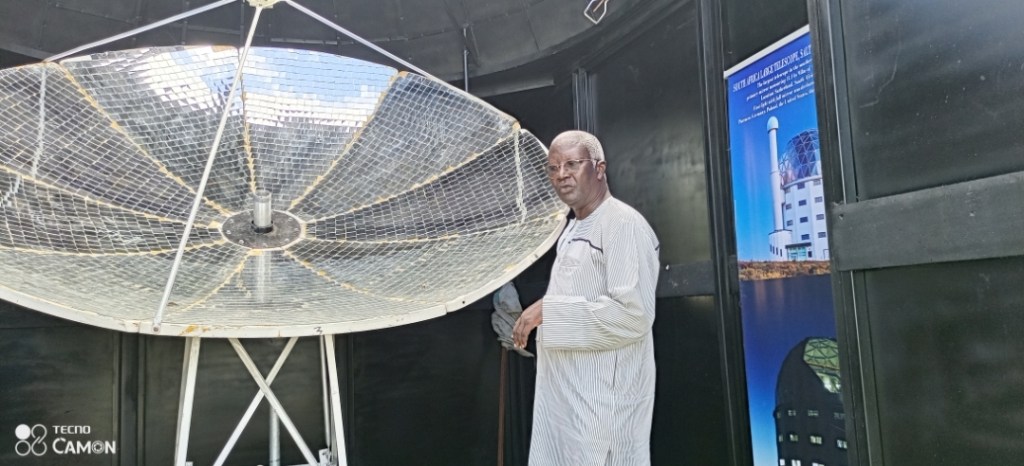
Mr Zubairu leverages his position in the physics laboratory to continue his research and development in optical science and telescopic lenses, leading to the successful creation of 4x40mm Binoculars. Despite his achievements, Nigeria and other African countries cannot produce binoculars, a technical knowledge Zubairu demonstrated over three decades ago.
Zubairu finds it ironic that Nigeria still cannot produce basic instruments like binoculars, telescopes, and sniper lenses, despite how easy it is to do so. He remarked, “It is funny to note that until now, Nigeria does not produce basic instruments like binoculars, telescopes, and sniper lenses, even though it is very easy to do so.”
Mr Zubairu refused to let the Nigerian government’s cold attitude dampen his inner fires of creativity and research and continued exploring various astronomy fields using his locally fabricated lenses. He further improved his first binoculars, the 4x40mm ZB, and sent a letter to the then Chief of Army Staff, General Alwali Kazir. Impressed by his work, General Kazir invited him to present it before an army council at the Army headquarters.
During the presentation, Mr Zubairu showcased his capabilities and spoke about infrared technology. He explained the core components of infrared and how it could support the military in tackling the challenges of fighting at night. He further highlighted that they had the idea and skills to develop their infrared facility for rifles, binoculars, flying jets, and other long-range targeting weapons.
According to Mr Zubairu, the army council approved his proposal, and some funds were released to start work on night viewing instruments, including the infrared and light intensifier. However, with the appointment of General Ishaya Bamaiyi as the new Chief of Army Staff, the project was terminated, as he did not appreciate its significance.
Fortunately, General TL Ashei, the Chief of Army Policy and Plans at the time believed in the project and gave Mr. Zubairu a letter of referral to the Federal Ministry of Science and Technology, ensuring that the project did not die naturally. The late General Sam Momah, the Minister of Science and Technology at the time, was interested in the project and directed Mr Zubairu to proceed to the Science Equipment Development Institute (SEDI) in Enugu. He received a recommendation from the institution to the minister on the need to sponsor the project.”
After a few months, Mr Zubairu received approval for the project, and a cheque was issued. However, the cheque was made to SEDI, not Zubairu, with a cover letter stating that the funds were meant for him and not the institution. Mr Zubairu planned to work through NASENI, a federal government agency that oversees all centres involved in engineering projects.
Despite receiving the funds, Mr Zubairu faced several challenges during the project’s development. He was frustrated by SEDI’s lack of support. They did not engineer or produce the body for him, despite him designing the infrared device and light intensifiers and acquiring all the required lenses. Consequently, he wrote a report to inform the ministry of the setback, but they have not responded since then.
Mr Zubairu returned to his work at the University of Maiduguri, designing and fabricating prototypes of refracting astronomical telescopes and sniper telescopes for rifles. In 2004, he was introduced to Major General Edo Wande, the Director-General of the Defence Industry Company of Nigeria (DICON), who invited him to design and construct a prototype of a C2-sight for an 88mm mortar gun. Although Mr Zubairu submitted the prototype within four months, no further development occurred. His work was later featured at the 2004 NUC research exhibition in Abuja, and some military generals appreciated his work. However, upon returning to Maiduguri, he encountered military problems.
“After the exhibition, I returned to Maiduguri and was sought out by military intelligence operatives who had received a signal from their Director MI about my project. They wanted to see my snipers’ prototypes and had initially intended to harass me. However, after I visited the barracks and explained that universities worldwide teach all kinds of gadgets, military and civil, they became interested. Unfortunately, the General who had taken an interest in my work retired, and nothing came of it.
A shift to lunar telescoping
Mr Zubairu concluded that the Nigerian military was not interested in his work, despite his efforts to show them how his projects could help solve their non-ballistic hardware needs. Frustrated, he put his quest to design sniper rifle telescopes aside and shifted his focus to creating telescopes for lunar movement instead. His experience with the military taught him that critical projects often depend on the interest or passion of a single individual. Once that person is no longer in charge, the project dies because there is no institutional interest or framework to sustain it, according to Mr Zubairu.
Uncertain of his next steps, Mr Zubairu shifted his research focus toward designing telescopes for lunar movements. Through his work, he was able to calibrate a telescope that accurately monitors the moon’s movements, allowing him to create a calendar based on the Islamic lunar cycle.
After nine years of painstaking work, he could tabulate the calendar for a 33-year cycle. He had to enter each suggestion into the columns one by one manually, and by the time he reached the 33rd year, the suggestion returned exactly where he had started – this was the furthest he had gone in lunar research.
According to Mr Zubairu, his findings are original, which is why the Saudi Arabian journal, Astronomic, was interested in publishing them. Despite not receiving recognition in his home country, Mr Zubairu’s book is now available on Amazon’s online marketplace.
In the future, this newspaper will explore another ambitious project by Mr Zubairu in space observation science. This project is currently in progress at the UNIMAID Campus.
 Bay States News