Categories
Politics Press Release

Order Your Boys to Stop Destroying Our Campaign Billboards, NNPP tells Governor Zulum

The opposition New Nigeria Peoples Party (NNPP) in Borno state has called on the state governor, Babagana Zulum to order the supporters of his party, All Progressives Congress (APC), to stop destroying the opposition campaign billboards in the state.

The opposition party alleged that about 16 of its billboards displaying the impression of their Presidential candidate, Rabiu Musa Kwankwaso and that of a senatorial candidate for Borno Central, Attom Magira-Tom, have been destroyed or pulled down by supporters of the ruling APC in the state.

This allegation was contained in a signed statement sent to the newsroom of Bay-6 News Online by officials of the party.

The APC has however denied involvement in the alleged hostility towards rival parties in the state, while insisting that the claims were “concucted.”

But acording to state chairman of NNPP, Barrister Mohammed Mustapha, his party has the cause to replace several billboards that were destroyed by the supporters of the ruling party two weeks ago, but only to be destroyed again on the same night.

The opposition party chairman said they were informed by credible sources that their party campaign infrastructure were targeted for attack at the behest of the state governor, Professor Babagana Zulum.

The NNPP chairman said “the APC thugs” were not only destroying their billboards but also replacing same with their own (APC) Posters even though they had paid the Borno urban development board all the fees to secure the locations for the placements.

The opposition party chairman who had also shared photographs of the destroyed campaign billboard expressed disappointment at the ruling partys level of political intolerance so far demonstrated by the Governor and his ruling party.

The party, thereby, called on the Independent National Electoral Commission (INEC) and the security agencies to deploy relevant sections of the Electoral Act to check the excesses of the APC and its government.

“We, therefore, call on the APC-led government under Professor Babagana Zulum to call his party members to order, as there is a limit to indiscretion. We will continue to call our members to maintain orderliness; but will not tolerate further onslaught on our party campaign structures,” Barrister Mohammed warned. 

A billboard of NNPP allegedly destroyed by the APC thugs

Read the full text of the statement:

“The New Nigeria People’s Party (NNPP) Borno state chapter finds it highly imperative to draw the attention of the good people of Borno to the dangerous political trends capable of plunging our dear state into wanton violence and disruption of the emergent fragile peace that we have collectively fought for. 

It is alarming to note that no other group is leading this mundane and archaic politics of bitterness other than the ruling All Progressives Congress (APC) and its government under Professor Babagana Umara Zulum. A man who has been promoted as the people’s governor. 

It may interest the general public to note on Friday, January 20th, 2023, a second peace accord was signed by all the political parties, their leadership and candidates to demonstrate our readiness to support the Independent National Electoral Commission (INEC) to conduct peaceful, hitch-free and violence-free 2023 general election. 

That singular action, as organised by the National Peace Committee headed by the Former Head of State, General Abdulsalami Abubakar, gave all well-meaning Nigerians the confidence of having yet another democratic progress that will reflect the overwhelming wishes and aspirations of Nigerians. 

It is disheartening to say that we, the people of Borno state, having crept out of one of the ugliest insurgencies in recent times across the globe, may not benefit from the dividends of the Peace Accord signed by our leaders and elder statesmen of high repute. This is mainly due to the actions and negative body language of the ruling APC and its government in Borno state. 

The likes of political sages, like the Late Waziri Ibrahim of blessed memory, who was the proponent of “Politics Without Bitterness”, will be turning their grave in the face of the cruel politics being perpetrated in the state that once prides itself as the Home of Peace. 

We, the members of the NNPP, have been on the front burner of the victims of the political violence of the APC and its hired political thugs in recent times. 

On Friday, January 20, 2023, the campaign billboards of our Presidential candidate, His Excellency Rabiu Musa Kwankwaso, and that of the Borno Central Senatorial candidate, His Excellency Attom Magira Tom, were violently attacked and destroyed in strategic locations across the Maiduguri Metropolis and other major communities within the constituency. 

This attack on our campaign structures was coming barely two weeks after similar destruction was carried out on the same number of billboards. As law-abiding members of a party whose principles have resonated with the electorates, we did not call for counter-violence. Instead, we urged our teaming supporters to remain calm and law-abiding while the leadership of NNPP reported the matter to concerned security agencies. 

The Friday incident of an attack on our billboard was carried out in a coordinated fashion on the night of the very day we replaced our duly authorised billboards.

It is even more saddening to note that the APC and its thugs did not only destroy our billboards, but they also went ahead to replace the banners on them with those of some of their own APC candidates even though we have paid the Borno state government all the required fees for the advertisement permit. 

For the avoidance of doubts, we want the public to fact-check our claims by visiting the West-End Roundabout, the Dandal Police station Roundabout, the Post Office Roundabout, Opposite Metro Police Division, the Adjacent Government College Maiduguri, Adjacent FGC Monguno, Adjacent Umaru Shehu General Hospital, Airport Roundabout, LM Bakery Junction at GidanMadara, Bulunkutu Yan-Nono, Bama Road/Lagos Street Junction, Adjacent UBA along Sir Kashim Road,   and host of many other places to verify our claims. 

We want to kindly remind the general public that this attitude of violence by the APC and its government did not start today. 

It was on record that on August 25, 2022, the Borno state Secretariat of our great party NNPP was, in the most shameful manner, sealed by the Borno state Urban Development Board on the directives of the state governor. That incident happened about three days to the day the National leader and presidential candidate of the NNPP, His Excellency Dr Rabiu Musa Kwankwaso, was expected to visit the state and commission the Secretariat. 

On the same day, our Senatorial Candidate, and party leader in Borno state, His Excellency Attom Magira Tom, was unlawfully arrested and detained by the Nigeria police for many hours simply because he showed up at the Secretariat to find out what was going on. 

Similarly, on August 28, 2022, when our Presidential candidate visited Maiduguri to launch our party, NNPP, his convoy was brutally attacked on the way to the airport, and not less than ten of our vehicles were vandalised. 

All these unfortunate happenings are going on in our state at a time when the state is governed by a University Professor and member of the National Institute, who is supposed to be an intellectual and above board. 

In light of these ugly trends, coming weeks of the conduct of the general election, we call on the INEC to take disciplinary measures against the violation of the Electoral Act by the APC and its government. 

We are also worried that most of the destruction perpetrated on our billboards by the APC was done at locations where the offices of the security agencies are located, and nothing was done to prevent its continuous recurrence. 

We, therefore, call on the APC-led government under Professor Babagana Zulum to call his party members to order, as there is a limit to indiscretion. We will continue to call our members to order but will not tolerate further onslaught on our party campaign structures. ”

Chairman of the APC, Hon Dalori insisted that, “the NNPP is crying foul on the crushing victory by the APC-led government under the leadership of governor Babagana Zulum who in the last three and half years, was able to put smile on the faces of Borno people through dividends of democracy and inclusiveness.”

Meanwhile, a mainstream newspaper has quoted the APC chairman, Ali Bukar Dalori, denying the allegation and stressing that “the NNPP is concocting lies against the ruling APC.”

“The APC and its teaming supporters are peace-loving individuals who are poised to ensure Borno sustains its developmental strides under the good leadership qualities of Governor Zulum,” the reported quoted the APC chairman who this newsroom has not been able to reach at the moment.

*You are reading this story at no cost, but you can only support us continue this good work if you LIKE, COMMENT and SHARE this report by clicking the handdles below👇

Categories
Armed Violence Foreign News

Burkina Faso Army Frees 66 Women, Children Abducted By Non-state Actors 

Officials of the Burkina Faso government have confirmed the country’s army had, on Saturday, secured the release of 66 women and children who were last week abducted by a group of Islamic extremists. 

The 66 women and children were abducted in the countryside while collecting wild fruit near the town of Arbinda in Soum province when the Islamic extremists seized them on Jan. 12th and 13th. 

The country’s security forces orchestrated a rescue operation “and found 27 adult women and 39 babies, children and young girls in the adjacent Centre-North province, according to the West African country’s National broadcaster, RTB. 

The report said armed forces had discovered the hostages during a military operation in the Center-North region. The persons rescued comprised 27 adult women and 39 babies, children and young girls.  

Security sources said abductees were found in the Tougouri region, about 200 kilometres southern outline. Helicopters flew them to Ouagadougou, where senior army officers met them.

According to The Guardian report, “Extremists have besieged towns around the West African country, preventing Arabiaand goods from moving freely. The town of Arbinda has been under jihadi blockade for years, making women more vulnerable to attacks if they try to leave, rights groups say.

The Guardian said the Jihadi violence linked to al-Qaida and the Islamic State group had overrun Burkina Faso, killing thousands and displacing nearly 2 million people in the West African nation. The failure of successive governments to stop the fighting has caused widespread discontent and triggered two military coups in 2022.

The military junta that seized power in September, vowing to restore security, is still struggling to stem the other violence.

Categories
Features Health

Reframing Peace And Health In Northern Nigeria

Extracted from Natasha Chilambo’s Article, “Reimagining Health to Counter Violent Extremism

The Boko Haram conflict in north-east Nigeria has created a situation of acute and enduring humanitarian need over the past decade. Boko Haram has attacked both government forces and civilians, carried out suicide attacks, and mass kidnappings.

An estimated 41 thousand people have died, with more than three million people displaced by this conflict.

A narrow definition and operationalization of peace and security limits the breadth of the responses to conflict. State-sanctioned solutions have typically been militarized yet yielded limited success.

We have seen that simply eradicating the leader of this insurgency does not uproot an ideology that forms the basis for harm at this large a scale. An armed response is insufficient. Therefore, all stakeholders need to expand and reconfigure what constitutes a comprehensive response to the problems presented by Boko Haram. 

An appreciation of the relationship between trauma and violent extremism offers a vital key to a fuller approach to preventing and countering violent extremism.

Trauma, and ill mental health is rarely a consideration of insecurity. By centring trauma in managing violent extremism, we are made to consider the vulnerabilities of communities in greater detail and with greater care.

This lens offers more clues about how violent extremism manifests and is maintained because it requires the blurring of disciplinary confines and authentic interdisciplinary work. For example, a peacebuilding intervention would need to consider the psychological wellbeing of communities they seek to engage with—trauma may be a barrier to reconciliation.          

Using the trauma-violent extremism lens forces us to simultaneously expand our notions of health, as well as peace and security. Looking through this lens challenges the convenient myths of psychiatric universalism and perceiving violent extremism as a phenomenon requiring a predominantly militarized response. Health as a bridge to peace is a useful framework that illustrates the richness of having expansive notions of health and peace and security. 

In the Neem Foundation’s Counselling on Wheels programme, interventions are designed and delivered predominantly by academics and practitioners from the North East. Alongside these interventions, there is ongoing interdisciplinary research work capturing vast amounts of data.

A 2020 evaluation found that the Counselling on Wheels programme engaged close to two thousand people from a range of stakeholder groups, and over ten thousand people from more than forty local communities through psychotherapy interventions. The evidence demonstrated that the Counselling on Wheels programmes significantly reduced people’s mental distress as well as vulnerability to violent extremism.  

This model offers an entry point towards a decolonial approach to global mental health and peace and security. The researchers and practitioners within Neem reflect the diverse socio-political and economic backgrounds of the communities they serve, thus reducing the epistemic and experiential gap. Neem challenges existing power imbalances in knowledge production and the practices that emerge from it by decentring hegemonic Western definitions of mental distress and insecurity. Instead, the organization reconfigures the definitions of health and insecurity by expanding them to include the structural factors at play. Health, therefore, ceases to merely be a biological phenomenon, and peace and security an issue that is dealt with simply by adopting militaristic approaches. This is exciting, but there is still some way to go in the aspiration of using health as a bridge to peace.  

While Counselling on Wheels boasts delivering psychosocial support and counselling services to over 31 thousand beneficiaries in Borno State, why isn’t the government relying on it? Perhaps this is to do with legitimacy. This programme sits between the tension of forming new ways whilst having to exists within paradigms that dictate a particular discourse and praxis. Counselling on Wheels must prove its legitimacy to the very systems it seeks to disrupt. Inherently, this requires compromise. For example, to capture the trauma of the affected communities, the counsellors may rely on psychological metric tools that were designed in the West. Whist this will yield data that demonstrates the scope of the problem, and the ways in which Counselling on Wheels has alleviated it, it risks reinforcing the very dominant framings of mental health it challenges. This has implications on the impact on policy and funding.  

Similarly, what are peace metrics beyond a lack of armed conflict – how will we know that Boko Haram is defeated? Different ways of understanding and sustaining peace will be needed to move beyond militarized peace and security.  

Organizations must develop an imagination and a maturity that helps them to discern which tools to use to dismantle the master’s house.

*The content of this article and it’s message are the opinion of the author and does not reflect the editorial view of Bay-6 News Online.
Categories
Politics Press Release

2023: Sultan of Sokoto Breaks Silence on Peter Obi Endorsement, Lambasts ‘Obidients’

The Sultan of Sokoto, Alhaji Muhammad Sa’ad Abubakar, has described as irresponsible the attempt by the campaign of the Labour Party’s Presidential candidate Peter Obi to drag him into the murky water of the 2023 election.

The foremost Islamic religious leader was quoted in a doctored document saying he should be held responsible if Peter Obi didn’t perform well as President of Nigeria. A statement which ostensibly infers that he has endorsed Mr Obi’s presidential ambition.

The purported message went wild in circulation even though many Nigerians who knew the Islamic leader and statesman discountenanced it.

The issue is just a confirmation of the volume of fake news that has shrouded the information space from where Nigerians are supposed to make informed decisions on their right candidate.

Reacting to the sad development, the media team stated to absolve the monarch even as they did not hide their anger toward the Obidients for falsely attributing such uncanny information to His Royal Majesty, the Sultan.

The response reads:

IGNORE IRRESPONSIBLE ATTEMPT TO DRAG SULTAN INTO POLITICS of 2023 BY PETER OBI CAMPAIGNERS

The attention of Media Team of Sultan of Sokoto, Alhaji Muhammad Sa’ad Abubakar, CFR, mni, has been drawn to a statement circulating on social media titled, “BREAKING: SULTAN OF SOKOTO WRITES” with an opening credited to Sultan purportedly saying, “Hold me responsible if Peter Obi didn’t perform well, the problem of the North is from the north, not Peter Obi or an Igbo man, it will be worst and more deadly for the North if Tinubu wins, if they tell you an Igbo man is the problem of Nigeria, tell them Igbo man never rule Nigeria before and north is world poverty capital”.

Ordinarily the statement should not be dignified with a pinch of reaction but because of the need to put the record straight for the sake of truth seeking Nigerians. Recall that this is not the first time such misleading statement would be circulated in effort to climb on the influential personality and name of the Sultan to score political goals. Unfortunately for the these pitiable political campaigners, Sultan of Sokoto is – strictly speaking – a traditional ruler and leader of Muslims of Africa’s most populous country. Moreso, as a retired Army General, his discipline, commitment and unalloyed to Nigeria is non-nogotiable.

For the avoidance of doubt, the statement is fake because such an irresponsible write-up, credited to him, could not have emanated from anywhere near or around His Eminence Alhaji Muhammad Sa’ad Abubakar, CFR, mni, the Sultan of Sokoto and President General of the Nigerian Supreme Council for Islamic Affairs (NSCIA).

Between Wednesday and Thursday, the Sultan played host to several figures including the outgoing and new General Officers Commanding (GOCs), Eighth Division Nigerian Army, Sokoto, Major Generals O. Bassey and Godwin Mutkut, respectively, Vice Presidential Candidate of the All Progressives Congress (APC), Senator Kashim Shettima, among others.

It would interest Nigerians to know that Presidential Candidate of the Labour Party (LP), Dr. Peter Obi, was not one of those that paid visit to the palace, be it on Wednesday or Thursday. So, how some agents of discord whose stock-in-trade is to thrive on cooking falsehoods and peddling of Fame news think that they can get through with this remains unknown to common sense.

The simple challenge is to ask them to publish a copy of the letter purportedly written by the Sultan or a video or audio clip where he endorsed Peter Obi and denied APC Presidential Candidate Asiwaju Bola Ahmed Tinubu as contained in their peddled fakeness. If they cannot, and of a surety they cannot, they should desist from this indefensible claim and unpardonable lie using the good bane of his His Eminence because it will backfire.

It should, however, be made clear to the good people of Nigeria that this , like many others in the past by the Peter Obi campaigners, would not stop the Sultan from continuing to play his role as a multifaceted leader and father of all and so, his doors will remain open to all aspirants across all parties and other meaningful people from across the country.

More important to Sultan Sa’ad Abubakar at this time and always are security, peace and unity of Nigeria, especially as the nation is fast moving into its long planned and heavily invested general elections. He will continue to support all efforts that will lead to success of the election process. So, let any incoherent claims of naysayers be ignored. Sultan is not a politician.

PRINCE BASHIR ADEFAKA,
For: Media Team of the Sultan of Sokoto

Thursday January 19, 2023.

Categories
Armed Violence Features Uncategorized

The Buni Yadi Tragedy: When The Boys Came

By Hauwa Shaffii Nuhu First Published in HumAngle (January 3, 2023)

The Buni Yadi massacre of 2014 was done methodically by the Boko Haram terror group. As teenage boys slept in their school hostel, the insurgents threw balls of fire under their bunk beds. In this series, we tell the stories from the perspective of staff, parents of the deceased boys, and one boy who survived.

“It will take a cinematographer’s eyes. Mine will not do, I admit. And she will need a button that makes and unmakes memories.” How Memory Unmakes Us, Gbenga Adesina. 

When Malam Umar crept out of hiding the next morning, his head dirtied and bloody after grazing it against the culvert he had hid under for hours, he found the lifeless bodies of students he had taught and known for years strewn about the compound.

Some of them had been slaughtered like livestock, the blood still all over their necks; others had burned to death, their hands still hung in the air from when they tried to writhe their way out of the flames. Others had bullet wounds all over their body. 

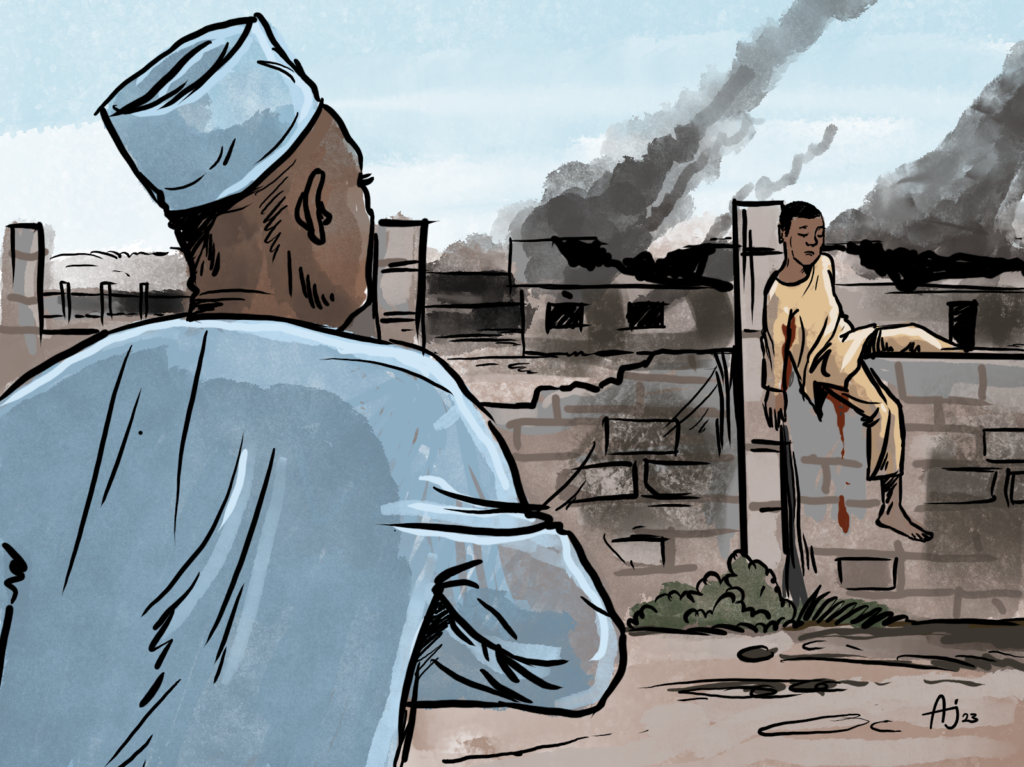
He advanced farther into the compound, his entire body engulfed with a blend of terror and grief. He saw a boy, perhaps 10 or 11, sitting at a gate entrance, one leg out of the premises, the other inside. The boy looked like he had been trying to jump over but, when he found himself sitting at the entrance, decided to just stay there. It was Umar’s first and only glimpse of hope that day. 

Umar and his companion rushed to the boy to hold him, and it was only then that they saw the bullet hole in his body and realised the boy had not slept off, nor was he merely resting. He was dead. He had been shot while attempting to leap out. 

There are many things Umar found unforgivable about that night of the Buni Yadi massacre. From his 19-year-old daughter, who sustained severe burn injuries, to the sight of the bodies of dead children strewn about the school, but the image of the 10-year-old boy is what has haunted him the most in the years that followed.

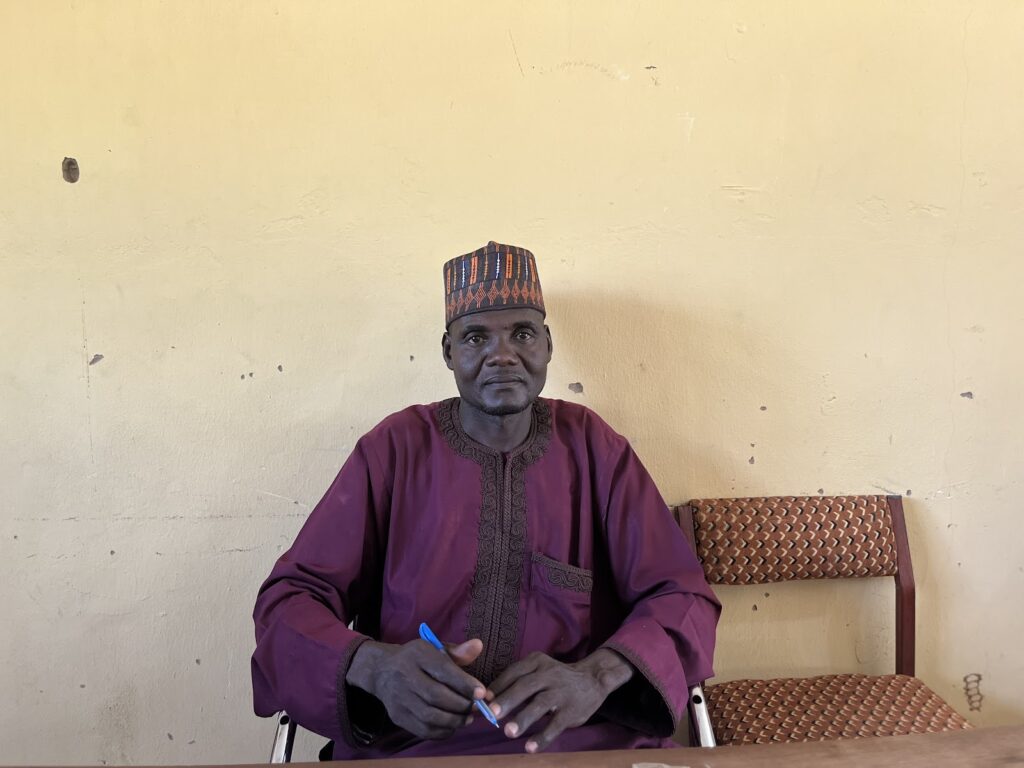
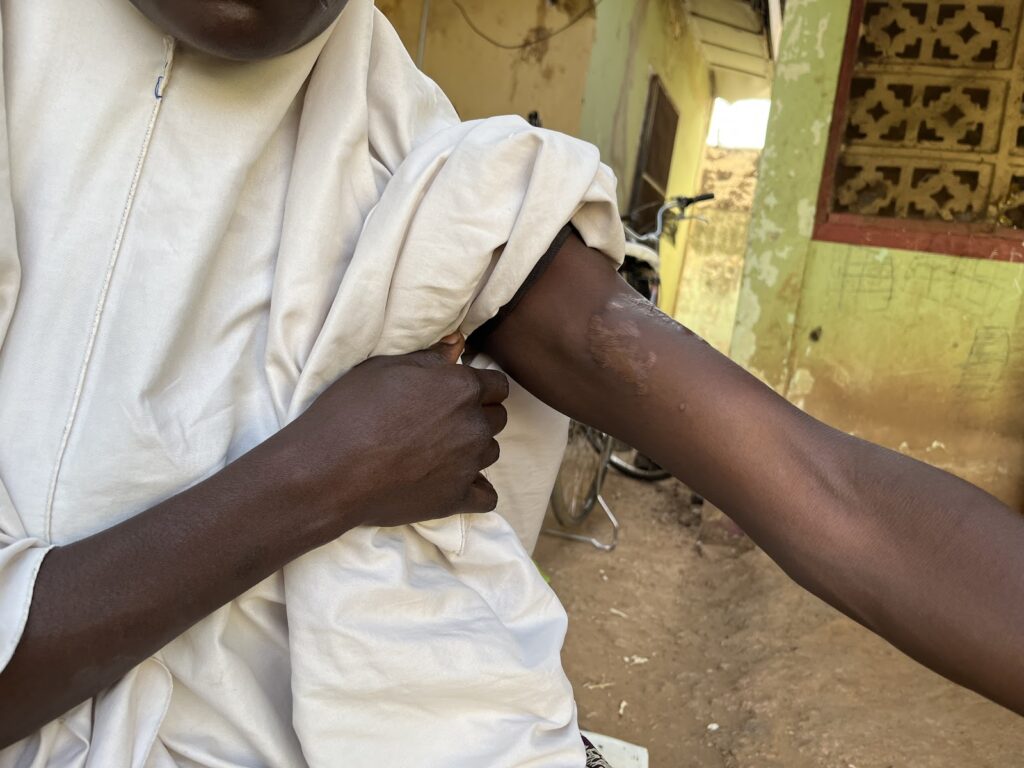
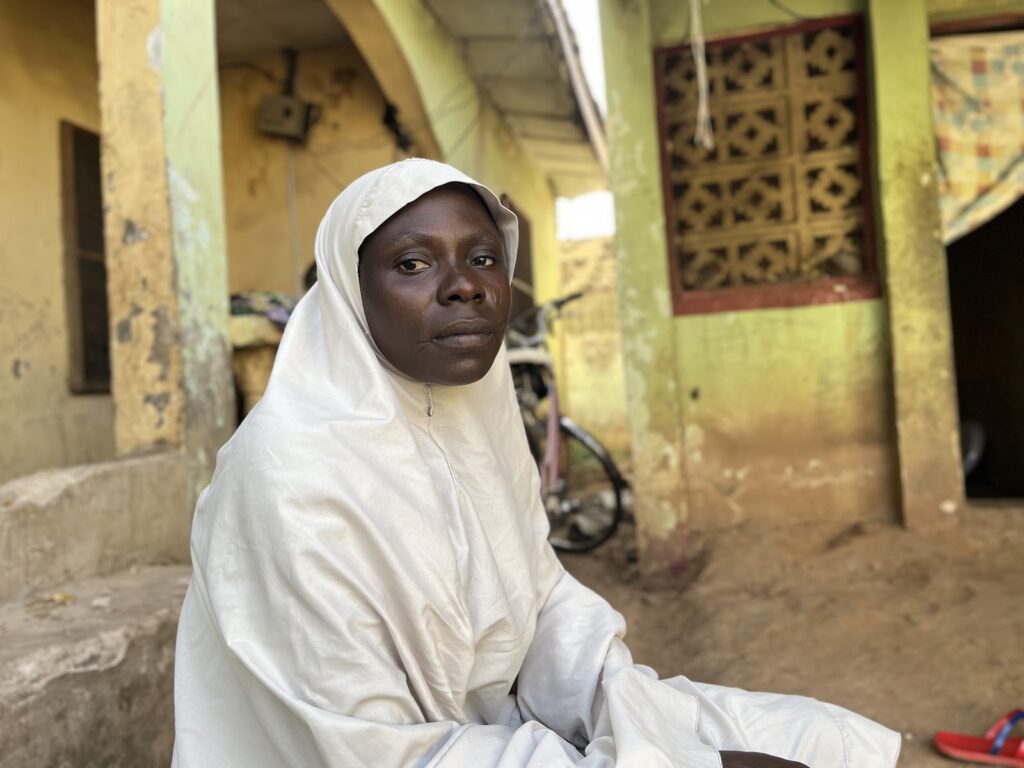
Malam Umar in Potiskum, Northeast Nigeria. Photo: Hauwa Shaffii Nuhu/HumAngle.

“He was just a boy,” he tells me one November afternoon in his office in Potiskum, Northeast Nigeria. And even now, the pain is evident in his eyes. He looks as though he is watching the boy again.  

“He was just a boy,” he says again. 

“Very horrible. He was in JSS1. What could he have known about anything? About school or government or terrorism? What concerned that little boy with all that? He did not deserve that.”

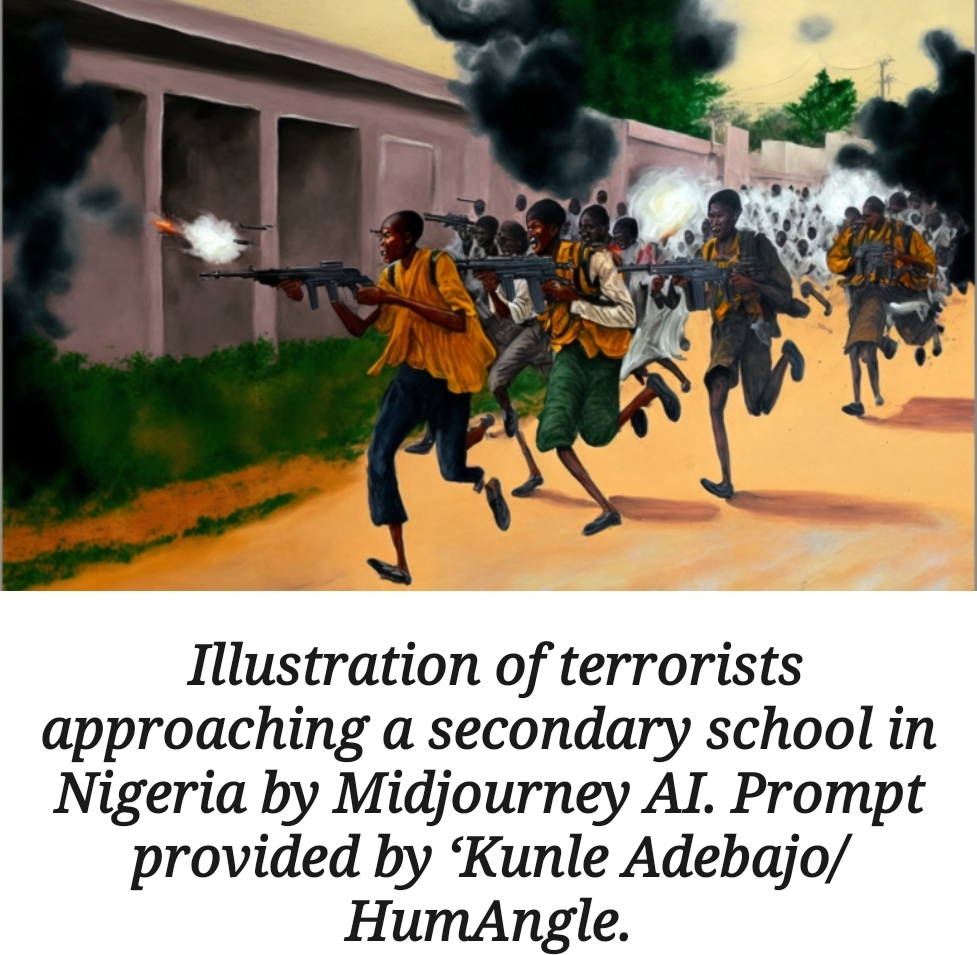
The Boko Haram insurgency, which had erupted five years before, did not care about the boy’s age or innocence. In their anti-school campaign, they had stormed the school the night before in trucks and massacred at least 29 teenage schoolboys, before setting every building in the compound on fire. Today it is known as the Buni Yadi Massacre. The 10-year-old boy and all the other boys who were killed are remembered as the Buni Yadi heroes. 

As Umar spoke about the events of that day, I was reminded at intervals of lines from a poem by the Nigerian-born poet, Gbenga Adesina, that appears in his chapbook of poetry. In the poem How Memory Unmakes Us, Adesina imagines how a filmmaker might record the scene of the Buni Yadi massacre and present the horrors to the world. He writes: “We are trying to pause the camera now, bidding the cinematographer to please press the button that unmakes memories.” 

The Buni Yadi massacre has slipped under the consciousness of many Nigerians. Media reports that were later done about it got many of the details mixed up; some said 29 boys were killed. Others said 59. Some even said the girls had been abducted. Survivors feel it has not received the required amount of attention and investigation for reasons that remain unclear. 

Many of the people I spoke to about the attack said they were speaking about it to the media for the first time.

Illustration. Akila Jibrin/HumAngle.

Feb. 24, 2014

The year the Abubakar Shekau-led Boko Haram stormed the Federal Government College Buni Yadi and slaughtered teenage schoolboys for daring to go to school, there had been a water problem in the town. 

Every evening, residents of the staff quarters in the school would file out to the reservoir that stood in front of the principal’s house to fetch water to store in their houses for the next day. On the evening of the attack, they did the same. 

When Umar and his family settled back inside their house in the quarters, as he attempted to drift off to sleep, he began to hear what sounded like a commotion from a distance. He was not immediately sure what was happening. Shortly after the commotion started, he heard the collective voices of men shouting Allahu Akbar. A Muslim himself, he knew that Muslims exclaim that way in shock, joy, or even grief. And so, even then he did not guess what was happening. It was, at best, a celebration and, at worst, a religious crisis.

Then, the rapid sounds of gunshots tore through the night, and he knew then they were under attack.

“I said to myself, ‘the boys’ have come today.” 

The staff had spent the previous weeks in tension over the security of the school. It was the year that the terror group, whose existence was centred around an ideology that opposed ‘Western education’ among other things, had carried out many attacks on schools. In fact, not long before, they had attacked a nearby college of agriculture. 

The terror group had already wreaked havoc in neighbouring Borno state, where thousands of people were being displaced by the violence from their homes in places like Boboshe, Kirawa, Nguro Soye, and Bama. That year and the year after, the insurgency reached its peak. In 2014 alone, attacks, including bomb detonations, were recorded in major locations like mosques and markets in JosMaiduguri, and Kano. Later in the year, they would carry out hostage kidnappings, such as the Chibok abduction of over 200 schoolgirls, catching the attention of the world. 

As insecurity loomed over the entire region and seemed to be drawing nearer to Buni Yadi, teachers held countless meetings with the school principal, asking him to consider either closing down the school or relocating it. They suggested moving to the state capital, merging with another school. They feared they were a natural target for Boko Haram. The principal assured them always that there was no need to worry, that he was in constant communication with the military “and they were on top of the situation.” The man had complete confidence in the efforts of the troops, former staff told me. Sometimes, people in the school heard from outsiders that Boko Haram terrorists were attacking a nearby town. Fearing that the school was the next target, both students and staff would all flee into the bush for days. Students whose families lived nearby ran to their homes to stay for a few days before returning to school. 

The school was no longer comfortable for them. 

When Umar heard the gunshots, he knew he had to run. Once the insurgents were done with the students, they would come down to the staff quarters. And while he was confident that they would not harm his wife and daughters, he was sure they would kill him. He explained this to his family. 

“We were merely 500 metres away from the boys’ hostel. My wife said no when I said I was leaving, she said I should not go. I said they would kill me if they came and met me,” so he left. 

His wife would later tell him that when the terrorists made their way to the house, they asked if there were any men in the house. 

In the pitch dark of the night, he struggled to find his way around the compound. At some point, he found himself sitting under a culvert that had been constructed a little distance from the staff quarters. From there, he heard the rapid gunshots in the boys’ hostel as the massacre happened. 

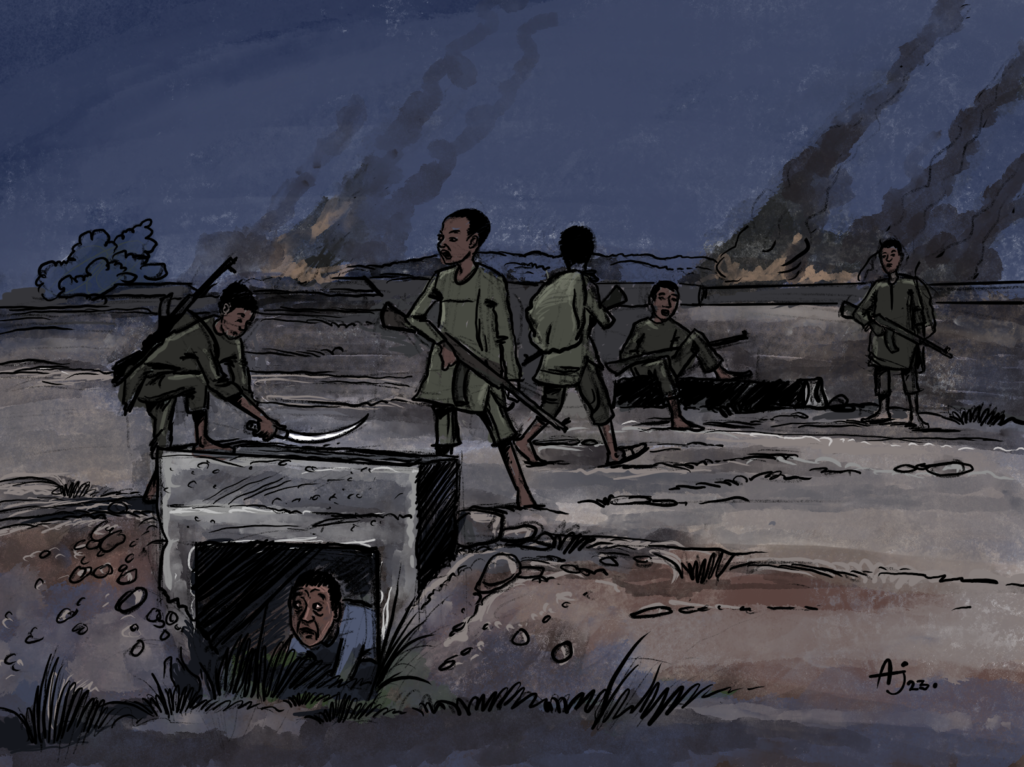
Illustration. Akila Jibrin/HumAngle.

Shortly after, some of the insurgents made their way to the surface atop the culvert he was hiding under, and it was then that he got a view of them. What he saw shocked him.

“Many of them were just boys fa,” he says. “They were very little boys, some as young as 13 or 14. One of them held a rifle, he looked like if I held him, he would just break in my hands. And they were all wearing camouflage. Dressed like members of the army.” Because they had already set fire to the buildings, the place was somewhat illuminated enough for him to see them from where he was hiding. 

He tried to listen in on their conversations, but they spoke mostly in Kanuri, a Borno language he did not understand. Suddenly, one of them took his knife and began to sharpen it against the surface of where they were sitting, all the while chatting with his companions. 

That would come to mind hours later when Umar saw some of the bodies of the slaughtered children. 

From the conversations Umar did manage to make out, he learned that the boys did not know where they were. Some argued that they were in Maiduguri, some thought they were in Damaturu, and others thought they were in Buni Yadi.

“Maybe they were not told exactly where they were going. They were only told they would be going for Jihad,” Malam Umar says. 

Most of the boys had so much load on their backs, though Umar could not tell what exactly was in the luggage. He remembers that it was so heavy that some of them walked with difficulty. They stormed the principal’s residence and began to loot the things inside it, loading them on the vehicles parked outside. The principal, fortunately, had been out of town. 

When they finished loading the vehicles, they realised they could not move them since they did not have the keys. In frustration, they set fire to the vehicles and all the things they loaded inside them.

When the day broke, even after the terrorists left, Umar could still hear the sound of burning buildings collapsing under the weight of fire. 

“They set fire to everything. Even the firewood that was just outside, the trees, everything. They set fire to everything.”

When he finally found the courage to escape hiding, he saw two young girls in the distance. At first, he thought it was the terrorists, and he mused to himself that after all the time he had spent in hiding, he would now come face to face with them. But soon he realised they were students.

The first thing he did was to return to his family in the staff quarters to ensure they were okay. They were not. As he had first feared, the terrorists had found their way to the quarters after they were done in the boys’ hostel and set fire to houses. His house was no different. They had set fire to the house while his wife and daughters were in it. They all survived by finding their way out before it eventually ate its way through the entire building, but one of his daughters was caught in it longer than everyone. She sustained severe burns across her thighs, chest, and arms. Habiba

Habiba shows the burns on her hand. Photo: Hauwa Shaffii Nuhu/HumAngle. 

But Umar did not know this at the time. He had merely made sure they were alive and complete before hurrying off to the hostels to check on the boys. By then, residents of the town who lived nearby had begun to filter into the school, as well as some staff who survived. They all rushed to the hostel.

“What we saw when we got there was a litter of dead bodies. On the floor, on the walls, everywhere.”

“But there are no boys now. Only ash and screams and the flailing of arms.” — How Memory Unmakes Us, Gbenga Adesina. 

Aftermath 

The Buni Yadi massacre was done methodically. As the boys slept in their hostel, a section of the insurgents threw balls of fire under their bunk beds. That way, by the time they awoke or when the heat got to them, they would be jumping into the fire if they jumped off the beds.

As the children shouted for their lives as they burned, the terrorists taunted them. ‘Where are your soldiers? Let them come and rescue you.’

Some of them then stood outside windows, guns in hand, and gunned-down boys who tried to scale through the windows. 

In this way, there were very few survivors. 

“One would find up to five or six dead bodies outside one window. As they tried to jump out, they were being shot.”

When the military arrived at the scene after the attack, grieving staff of the school, angered by the slow response, asked where they were when they needed them the most. They responded that nobody had reported the attack to them while it happened. The response made many realise that the assurances they used to receive, that the military was on top of the situation, carrying out surveillance in their armoured tanks around the school every night to secure them, were false.

“Because if they had been truly doing that, they would have been aware of the attack. How could they have expected us to come to their barracks during the attack to report? The statement angered so many people that they nearly lynched the officer who made it,” a source who preferred to be unnamed said. 

Soon, parents started to troop into the school to search for their sons after the news began to spread. On entering the school, they would find the dead bodies of the children, and many collapsed at the gory sight. Finally, after some time, the bodies were taken to the hospital and the mortuary, and those who were alive but wounded were taken into the emergency wards of the hospital for treatment.

Still, there were parents who did not hear about the attack for many hours because of the poor network connectivity in areas where the insurgents operated in those years. 

Umar went along to the hospital with the bodies of his students. While there, news reached him that his own daughter back in the staff quarters was not well, so he hurried back to the school to meet his family. His daughter, Habiba, 19 at the time, was severely burnt. 

Habiba is now married with two kids. Photo: Hauwa Shaffii Nuhu/HumAngle.

 She was lying down on the bare floor. He asked if she could sit properly, but she groaned that she could not. He was unsure how to proceed after that. 

There were no vehicles left within the premises since they had all either been burnt or already used to convey the dead to the hospital. 

“We had to look for a push-push [a trolley for water kegs] to convey her and others to the hospital,” he recalls. 

Some of his other children could no longer see well due to the smoke they had to breathe in and be immersed in before they could break out of the building.

Luckily, treatment for them all at the hospital was free. 

“At that time, the policy was that anyone in Yobe who was admitted to the emergency unit would be treated free of charge. The then governor, Geidam, had also directed all survivors of the attack to be treated for free.” 

Not long after the attack, Umar moved his family away from Buni Yadi to Potiskum, Yobe state. The trauma was severe, and his residence had been burnt anyway. They also knew that the town had become more vulnerable to attacks. They turned out to be right because, not long after, the town fell to Boko Haram. 

A persistent memory

When Malam Umar sat huddled and in hiding long after the insurgents had gone, he thought it would be an unending night. But after hours of hiding, after he had heard them driving away, silence slowly returned. 

Then, he started to hear the call to prayer from far away. 

The adhan came to Umar as a shock. Because he saw, then, that life was going on all over the world beyond that school compound, beyond the deaths and tragedy and horrors of the night. And that shocked him.

How was it that another day had come, and people in the next town could go about their lives?

“After all these things that just happened?”

Adesina’s poem ends with lines that echo Umar’s bewilderment. 

The unbelievable fact of history that the sun came out later that day.”

Photo of Hauwa Shaffii Nuhu

Hauwa Shaffii Nuhu is HumAngle’s Managing editor, and according to the newspaper she has her by-lines in several international publications and is a recipient of several fellowships and an award.

Kindly help us to grow by liking and sharing this story using the handles below👇

Categories
Business & Economy News

Nigeria Government Quietly Approves ₦‎185 As New Petrol Pump Price 

A yet to be substantiated report, but already published by credible mainstream media, claims that the Federal Government of Nigeria may have “quietly” approved ₦185 as the new petrol pump price per liter.

The Guardian newspaper said it had received exclusive information that “the approved pump price was communicated to significant marketers in a memo early Friday, Jan. 13, 2023. 

Media reports claim that “fuel stations in Lagos have started adjusting their pump price to the approved ₦‎185 per liter.

Bay-6 News Online can report that the new price regime for petrol pump prices came after months of heightened scarcity and product sales beyond the general cost, especially in the northern part of the country. 

Though the scarcity has been felt nationwide since November of 2022, the northeast has battled with queues and lack of fuel since the beginning of 2022. 

In Borno and Yobe states, for example, fuel was sold between ₦250 and ₦310,until now, even though the official pump price was N165.

This news gathered that some significant marketers known for selling at the official rate of ₦165 were forced to jerk up their pump price to ₦200 per liter due to the austere economy. But the ₦‎200 per liter is still below the rate sold at the independent markets. 

It is expected that in the coming days, marketers will begin to adjust their pumps by next week. 

What’s your opinion on this report? 

Kindly like and share this report using the handles below. 👇

Categories
Education

UNIMAID Lists Out 18 Dress Code Violations That Can Lead to Student’s Suspension

The University of Maiduguri has released a list of 37 unpardonable offences that can lead to suspension and 18 of them are related to “indecent dressing” by students.

The list, which has already generated a lot of public debate, also include suspension of a student nursing mother reside in the hostel or takes her child to the classroom.

But the ones that are generating excitement is the list of offences around indecent dressing. For these 18 offences a student found guilty or in breach could be suspended for two semesters or less.

The rule says “Having multi-colour braid for female earns one semester suspension.

Offenses And Punishment 

  • Having multi-colour braid for female – 1 Semester Suspension 
  • Having coloured hair styling –  1 Semester Suspension 
  • Male having hair braid –  2 Semester Suspension 
  • Having dreadlocks by male or female –  1 Semester Suspension 
  • Spangled hair style for male –  2 Semester Suspension 
  • Wearing of caring for male couriers for female –  1 Semester Suspension 
  • Tattoo/piercing of body parts for lip plug/die, mouth plate, nosering and eyelet –  1 Semester Suspension 
  • Unconventional wearing of face cap –  1 Semester Suspension 
  • Wearing of tattered jeans both male and female –  1 Semester Suspension 
  • Wearing of micro/mini dress, crop tops/jump tops  1 Semester Suspension 
  • Wearing of off-shoulder/backless clothes –  1 Semester Suspension 
  • Wearing of transparent wears –  1 Semester Suspension 
  • Wearing of bum shorts –  1 Semester Suspension 
  • Wearing of ankle chain by female –  1 Semester Suspension 
  • Wearing of long eyelashes by female –  1 Semester Suspension 
  • Wearing of gown/blouse that exposes the navel or breast by female –  1 Semester Suspension 
  • Wearing of bathroom slippers to the classroom –  1 Semester Suspension 
  • Saggy/ass down for both male and female –  1 Semester Suspension 
  • Engaging in intimate open embrace (hugging/kissing) –  1 Semester Suspension 
  • Openly sitting on each other’s lap by opposite sex –  1 Semester Suspension 
  • Nursing mothers/pregnant student residing in the hostel –  1 Semester Suspension 
  • Bringing babies to the hostels/classroom –  1 Semester Suspension
Categories
Business & Economy News

Yobe Traders to Pay 35% Less on Shops in 5 Newly Commissioned Ultramodern Markets – Gov. Buni

First Published by The Humanitarian Times

It’s yet another happy moment for the people of Yobe state, Northeast Nigeria, when the state Governor, Mai Mala Buni, announced a 35 per cent discount for renting the shops in each of the five newly completed market complexes across the state.

The five markets located in Damaturu, Potiskum, Geidam, Gashua and Nguru have a total of 2500 shops built at the cost of 12.8 billion nairas.

The governor said making renting of the shop affordable will ease the cost of businesses and increase productivity among local traders.

Unveiling the subsidized rents on shops at a brief ceremony held on Wednesday in Damaturu, the governor said, “the 35 per cent subsidy followed the initially approved annual rents on shops, as recommended in the report of the Committee on the allocation of shops to traders and other businessmen and women in the state.”

“Their business could also thrive competitively at the completed five markets across the state,” he noted.

“The ground floor Prime View Double (PVD) shop, with an initial price of N468,000 rent per annum, is now reduced to N304, 200.

“The ground floor Prime View Single (PVS), initially at N390 000, is now to be rented out at N253, 500 a year.”

Besides, he added that the ground floor prime view with two faces to earn N442, 000 is now to be rented at N287, 300.00 per annum, while the ground floor shops and other doubles for N390, 000.00 is reduced to N253, 500.

“The ground floor single shops initially with an annual rent of N325 000 will now be slashed to N211, 250, while the ground floor shops with two faces are to attract N253, 500, as against the initial price of N390, 000.

For the shops upstairs, the governor disclosed that PVD had been reduced to N253, 500.00, as against the former rate of N390, 000 per annum.

The upstairs PVS will now cost N211, 250 against the initial fixed rent of N325, 000.

The upstairs prime view, with two faces, will attract an annual rent of N236, 600, while the upstairs others double is pegged at N169, 000.

Traders are to rent the upstairs single at N152, 100.

Kindly help us to like and share using the handles below👇

Categories
News Politics

President Buhari Extends IGP’s Tenure Beyond 2023 Elections

President of Nigeria, Muhammadu Buhari has prolonged the tenure of the country’s Inspector-General of Police (IGP), Usman Alkali Baba, beyond his retirement age.

The IGP was born on March 1, 1963, in the Geidam Local Government Area of Yobe State and enlisted in the Nigeria Police on March 15, 1988, at 25.

IGP Baba has been in the police force for about 35 years, the limit set for all civil servants to function before retirement. The law also said that a civil servant who attains the age of 60 should equally proceed on retirement.

The IGP’s date of birth and the date of enlistment coincides with the two requirements for retirement. Either way, his retirement is, by dual default, scheduled for March 2023.

The new Police Act has pegged the tenure of an IGP to four years. And IGP Baba is just in his second year.

However, the president has the power to keep his service chiefs or any other officer in whose services he finds pleasure beyond these constitutional barriers.

It was on that note that the Minister of Police Affairs, Mohammed Dingyadi, disclosed today that IGP Baba would tarry till the end of Buhari’s tenure or even slightly beyond that until a new President decides otherwise.

The minister confirmed that the IGP was supposed to retire “midway into the general elections”, but has already “gotten a letter of extension.”

The minister explained the Police Act 2020 has changed the rules for an IGP’s retirement, adding that the new law makes the tenure of the Police boss a four-year period.

By the provision of the Police Act 2020, the IG is now supposed to have a kind of four-year period and Mr. President has already given him a letter of appointment in that regard. So the issue of IG going out during this election period does not arise.”

Dingyadi said the FEC approved the draft bill for an Act to establish Nigeria Police Institutions, which he said is to provide legal backing to the existing training institutions across the country and not to build new ones

The minister said despite the public out about conduct of the police, “the level of corruption within the Nigeria Police has drastically reduced.”

IGP Baba was appointed to head the Nigeria police on April 6, 2021. The Police Council confirmed him as the substantive Inspector General of Police June of the same year.

Categories
News Politics

2023: Nigerian Judge Discards Lawyer’s Suite Challenging Muslim-Muslim Ticket

A Nigerian Judge, Justice Ahmed Ramat Mohammed, of the Federal High Court in Abuja, the nation’s capital, had on Wednesday, Jan.18, 2023, thrown out a suit by a rights lawyer seeking disqualification of the presidential candidate of the country’s ruling party, All Progressives Congress (APC) Bola Ahmed Tinubu over his choice of selecting a fellow Muslim as his running mate.

An Abuja-based legal practitioner, Osigwe Momoh, had his suit thrown out by the Judge on the grounds that it lacked locus standi.

Justice Mohammed maintained that the lawyer who is not a member of APC “and having not participated in the process that produced Tinubu and his running mate, Kashim Shetima, cannot query them on the nominations.”

The legal practitioner had in the suit wanted the court to issue an order “nullifying” the candidature of APC and Tinubu from participating in the presidential election on the ground that “the nomination of Muslim-Muslim candidacy is unconstitutional and against the spirit and letters of sections 14, 15 and 224 of the 1999 Constitution.”

Barrister Momoh had argued that “the Muslim-Muslim candidacy runs counter to the spirit of national cohesion, integration and unity.”

He requested the court for “an order of perpetual injunction to the Independent National Electoral Commission (INEC) from publishing the name of APC and its presidential candidate for the 2023 election.”

However, Justice Mohammed differed from the plaintiff on the legal right to initiate the case in the first place and subsequently threw it out in totality.

Justice Mohammed upheld the preliminary objection of APC and Tinubu and did not award any cost against the plaintiff.

This story is relevant to Bay-6 News because Kashim Shettima, the chosen running mate of Mr Tinubu and the Presidential candidate of the opposition People Democratic Party (PDP), Atiku Abubakar, are both from the northeast states of Borno and Adamawa. Bay-6 News covers the six states of the Northeast as the first catchment area before other parts of Nigeria and beyond.

Kindly like and share this story using the handles below👇

Design a site like this with WordPress.com
Get started