The Nigerian National Council of State (NCS) has ordered the Central Bank of Nigeria (CBN) to take urgent steps to arrest the scarcity of cash across the nation.
CBN Governor Godwin Emefiele was advised to make new naira notes available or re-circulate old naira notes to ease the suffering of Nigerians.
Attorney-General of the Federation and Minister of Justice, Abubakar Malami who was escorted. by Governors Babajide Sanwo-Olu (Lagos) and Darius Ishaku (Taraba) briefed State House Reporters on outcomes of the meeting.
AG Malami told journalists that two major issues were deliberated upon at the meeting.
He said the NCS deliberated on the level of preparedness for the general elections. The Chairman of the Independent National Electoral Commission (INEC), Professor Mahmood Yakubu, and the Inspector-General of Police (IGP), Alkali Baba, assured the nation’s leaders of sufficient readiness to conduct a hhitch-freepoll for nation.
On the new monetary policy, including the re-designing of some denominations of the naira, which evoked reactions, the Council concluded that the CBN should do more to ensure there is circulation of sufficient cash in the system to relieve the unnecessary pains people have so far gone through because of the policy.
“So by way of conclusion, the two major resolutions that were driven, arriving from the deliberations of the Council, are one that we are on course as far as election is concerned and we are happy with the level of preparation by INEC and the institutions,” Malami said.
“Two, relating to the naira re-designed policy, the policy stands, but then the Council agreed that there is need for aggressive action on the part of the Central Bank, as it relates to the implementation of the policy by way of ensuring adequate provision being made with regard to the supply of the naira in the system,” he said.
*You are reading this story at no cost, but you can only support us continue this good work if you LIKE, COMMENT and SHARE this report by clicking the handdles below👇
The Network of Civil Society organizations in Borno state, (NECSOB) has added its voice to the widespread condemnation that trails the #NewNairaNote controversy in the country.
NECSOB said though currency redesign is a common occurene glibally, Nigeria’s version is “wrongly timed and ill-preparedness on the part of the authorities.
In view of that, the civil society body find it imperative to make the follwing recommendations as a way out the nasty situation.
Members of the public should as a matter of necessity embraces the new development and devices every legal means necessary that will facilitate their transaction.
All commercial centers and public service providers (such as hospitals…) should as a matter of urgency create online payment platforms and POS devices to ease people’s hardship.
Security operative (DSS,EFCC…) should intensify in bringing sanity into these currency related crimes.
CBN should also make available to the public the daily allocations to commercial Bank branches in every state for accountability.
Network Providers should also try and upgrade their services to accommodate the abrupt pressure on these facilities.
Commercial Banks should also upgrade their servers to enable for smooth online transactions.
We also called on POS operators to deceased from illegal transactions that is exploiting unsuspected members of the public.
All filling stations should be compliant with the new cashless policy by providing e-payment devices across their dispensing pumps.
The general public are enjoined to remain Law abiding and carryout their activities within the provisions of the law.
*You are reading this story at no cost, but you can only support us continue this good work if you LIKE, COMMENT and SHARE this report by clicking the handdles below👇
Governor of Borno state has recently taken his campaign trail to the southern local governments of the state where he commissioned several capital projects executed by his administration in the past three years.
Top among the projects that have further endeared him more to the electorates is the mega water which has the capacity to store and distribute 1,250,000 litres of water at Mboa village in Chibok Local Government Area of Borno State.
Mboa, a village is located 5km from Chibok town, The newly commissioned water project is expected to serve over 40,000 residents of not just Mboa village but also of Chibok town and neighboring communities.
Officials said the water facility has a storage capacity of a 750,000-litre surface tank and a 500,000-litre overhead tank with water sources from 20 motorised boreholes.
“Access to portable water has been one of the major challenges of Chibok town,” Zulum said.
Zulum commissioning projects
“During our electioneering campaign, we promised you that if elected we shall address the water problems you face. This night we are here to commission a multi-million naira project which was executed to provide Chibok and its environs with water.”
Commissioner of Water Resources, Tijjani Alkali, explained that the water project is powered by 36,000 watts of solar and a 100 kva generating set.
New Schools for Damboans, Askiras
Governor Zulum’s working campaign tour moved to Gumsuri, a ward in Damboa LGA, to commission a senior secondary school on the same Monday night.
The governor commissioned a new junior secondary school in Askira town with classroom to contain about 1,000 students.
Each student of the new schools was handed art of uniforms, reading and writing materials as well as bicycles to ease transportation especially for those coming from distant places.
*You are reading this story at no cost, but you can only support us continue this good work if you LIKE, COMMENT and SHARE this report by clicking the handdles below👇
The Buni Yadi massacre of 2014 was done methodically by the Boko Haram terror group. As teenage boys slept in their school hostel, the insurgents threw balls of fire under their bunk beds. In this series, we tell the stories from the perspective of staff, parents of the deceased boys, and one boy who survived.
“It will take a cinematographer’s eyes. Mine will not do, I admit. And she will need a button that makes and unmakes memories.”— How Memory Unmakes Us, Gbenga Adesina.
When Malam Umar crept out of hiding the next morning, his head dirtied and bloody after grazing it against the culvert he had hid under for hours, he found the lifeless bodies of students he had taught and known for years strewn about the compound.
Some of them had been slaughtered like livestock, the blood still all over their necks; others had burned to death, their hands still hung in the air from when they tried to writhe their way out of the flames. Others had bullet wounds all over their body.
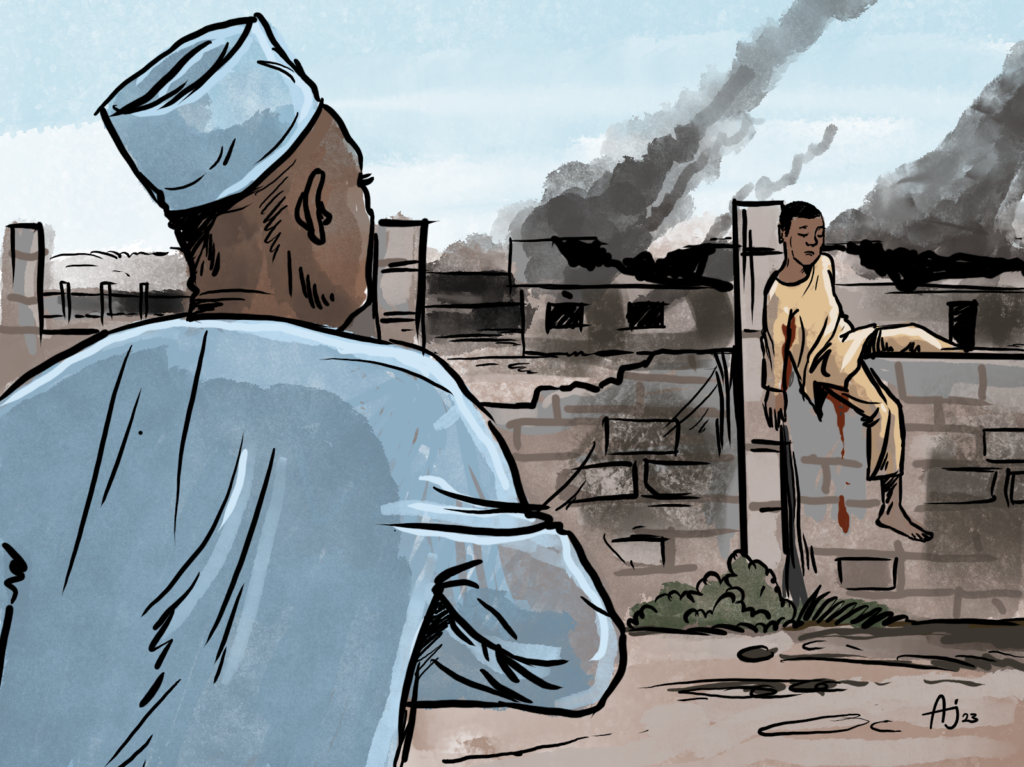
He advanced farther into the compound, his entire body engulfed with a blend of terror and grief. He saw a boy, perhaps 10 or 11, sitting at a gate entrance, one leg out of the premises, the other inside. The boy looked like he had been trying to jump over but, when he found himself sitting at the entrance, decided to just stay there. It was Umar’s first and only glimpse of hope that day.
Umar and his companion rushed to the boy to hold him, and it was only then that they saw the bullet hole in his body and realised the boy had not slept off, nor was he merely resting. He was dead. He had been shot while attempting to leap out.
There are many things Umar found unforgivable about that night of the Buni Yadi massacre. From his 19-year-old daughter, who sustained severe burn injuries, to the sight of the bodies of dead children strewn about the school, but the image of the 10-year-old boy is what has haunted him the most in the years that followed.
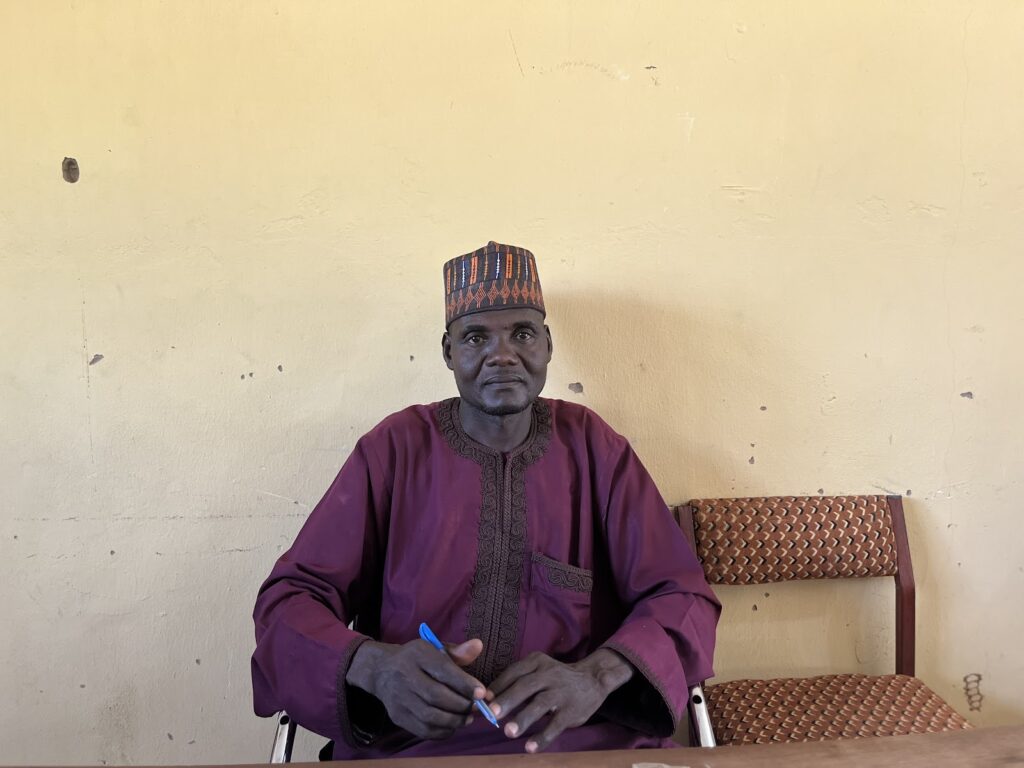
Malam Umar in Potiskum, Northeast Nigeria. Photo: Hauwa Shaffii Nuhu/HumAngle.
“He was just a boy,” he tells me one November afternoon in his office in Potiskum, Northeast Nigeria. And even now, the pain is evident in his eyes. He looks as though he is watching the boy again.
“He was just a boy,” he says again.
“Very horrible. He was in JSS1. What could he have known about anything? About school or government or terrorism? What concerned that little boy with all that? He did not deserve that.”
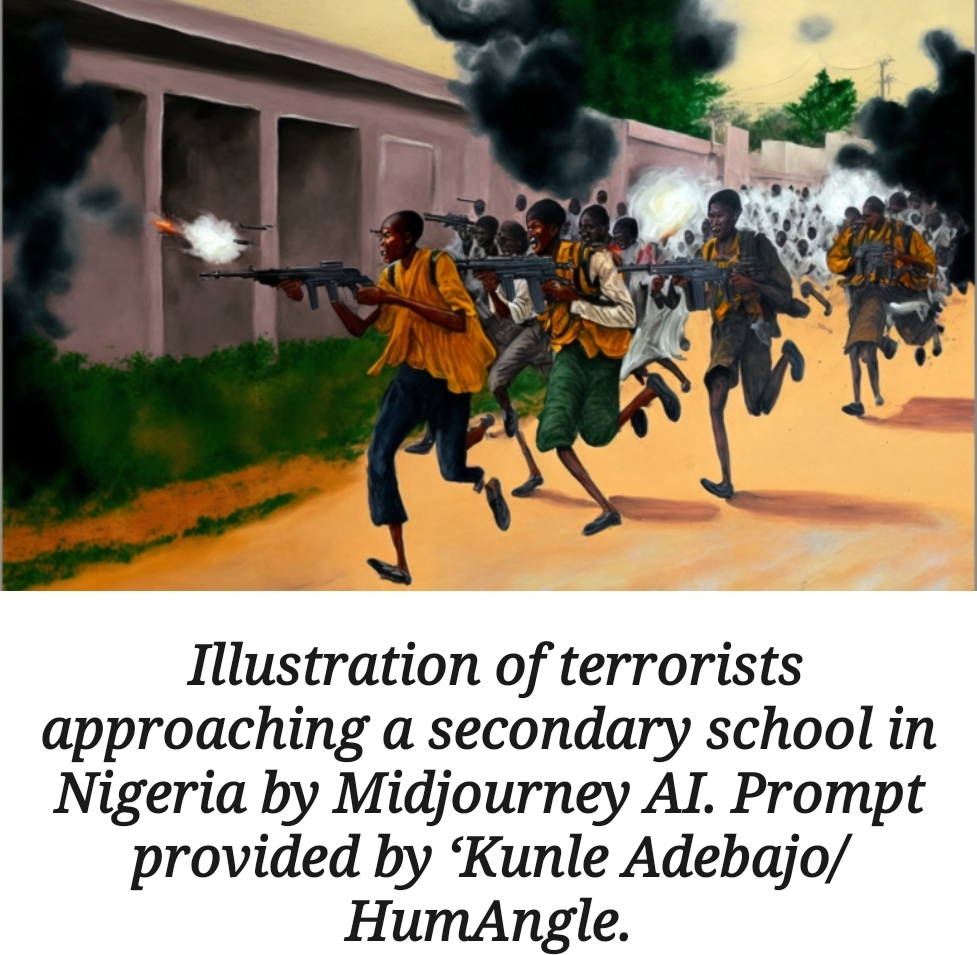
The Boko Haram insurgency, which had erupted five years before, did not care about the boy’s age or innocence. In their anti-school campaign, they had stormed the school the night before in trucks and massacred at least 29 teenage schoolboys, before setting every building in the compound on fire. Today it is known as the Buni Yadi Massacre. The 10-year-old boy and all the other boys who were killed are remembered as the Buni Yadi heroes.
As Umar spoke about the events of that day, I was reminded at intervals of lines from a poem by the Nigerian-born poet, Gbenga Adesina, that appears in his chapbook of poetry. In the poem How Memory Unmakes Us, Adesina imagines how a filmmaker might record the scene of the Buni Yadi massacre and present the horrors to the world. He writes: “We are trying to pause the camera now, bidding the cinematographer to please press the button that unmakes memories.”
The Buni Yadi massacre has slipped under the consciousness of many Nigerians. Media reports that were later done about it got many of the details mixed up; some said 29 boys were killed. Others said 59. Some even said the girls had been abducted. Survivors feel it has not received the required amount of attention and investigation for reasons that remain unclear.
Many of the people I spoke to about the attack said they were speaking about it to the media for the first time.
Illustration. Akila Jibrin/HumAngle.
Feb. 24, 2014
The year the Abubakar Shekau-led Boko Haram stormed the Federal Government College Buni Yadi and slaughtered teenage schoolboys for daring to go to school, there had been a water problem in the town.
Every evening, residents of the staff quarters in the school would file out to the reservoir that stood in front of the principal’s house to fetch water to store in their houses for the next day. On the evening of the attack, they did the same.
When Umar and his family settled back inside their house in the quarters, as he attempted to drift off to sleep, he began to hear what sounded like a commotion from a distance. He was not immediately sure what was happening. Shortly after the commotion started, he heard the collective voices of men shouting Allahu Akbar. A Muslim himself, he knew that Muslims exclaim that way in shock, joy, or even grief. And so, even then he did not guess what was happening. It was, at best, a celebration and, at worst, a religious crisis.
Then, the rapid sounds of gunshots tore through the night, and he knew then they were under attack.
“I said to myself, ‘the boys’ have come today.”
The staff had spent the previous weeks in tension over the security of the school. It was the year that the terror group, whose existence was centred around an ideology that opposed ‘Western education’ among other things, had carried out many attacks on schools. In fact, not long before, they had attacked a nearby college of agriculture.
The terror group had already wreaked havoc in neighbouring Borno state, where thousands of people were being displaced by the violence from their homes in places like Boboshe, Kirawa, Nguro Soye, and Bama. That year and the year after, the insurgency reached its peak. In 2014 alone, attacks, including bomb detonations, were recorded in major locations like mosques and markets in Jos, Maiduguri, and Kano. Later in the year, they would carry out hostage kidnappings, such as the Chibok abduction of over 200 schoolgirls, catching the attention of the world.
As insecurity loomed over the entire region and seemed to be drawing nearer to Buni Yadi, teachers held countless meetings with the school principal, asking him to consider either closing down the school or relocating it. They suggested moving to the state capital, merging with another school. They feared they were a natural target for Boko Haram. The principal assured them always that there was no need to worry, that he was in constant communication with the military “and they were on top of the situation.” The man had complete confidence in the efforts of the troops, former staff told me. Sometimes, people in the school heard from outsiders that Boko Haram terrorists were attacking a nearby town. Fearing that the school was the next target, both students and staff would all flee into the bush for days. Students whose families lived nearby ran to their homes to stay for a few days before returning to school.
The school was no longer comfortable for them.
When Umar heard the gunshots, he knew he had to run. Once the insurgents were done with the students, they would come down to the staff quarters. And while he was confident that they would not harm his wife and daughters, he was sure they would kill him. He explained this to his family.
“We were merely 500 metres away from the boys’ hostel. My wife said no when I said I was leaving, she said I should not go. I said they would kill me if they came and met me,” so he left.
His wife would later tell him that when the terrorists made their way to the house, they asked if there were any men in the house.
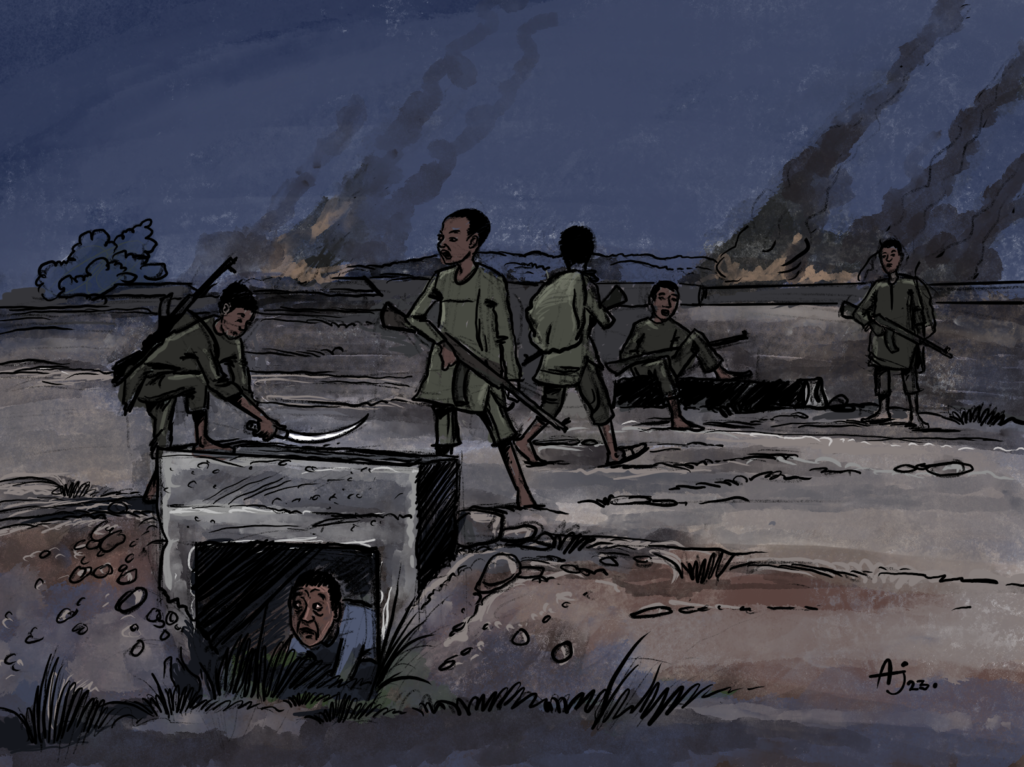
In the pitch dark of the night, he struggled to find his way around the compound. At some point, he found himself sitting under a culvert that had been constructed a little distance from the staff quarters. From there, he heard the rapid gunshots in the boys’ hostel as the massacre happened.
Illustration. Akila Jibrin/HumAngle.
Shortly after, some of the insurgents made their way to the surface atop the culvert he was hiding under, and it was then that he got a view of them. What he saw shocked him.
“Many of them were just boys fa,” he says. “They were very little boys, some as young as 13 or 14. One of them held a rifle, he looked like if I held him, he would just break in my hands. And they were all wearing camouflage. Dressed like members of the army.” Because they had already set fire to the buildings, the place was somewhat illuminated enough for him to see them from where he was hiding.
He tried to listen in on their conversations, but they spoke mostly in Kanuri, a Borno language he did not understand. Suddenly, one of them took his knife and began to sharpen it against the surface of where they were sitting, all the while chatting with his companions.
That would come to mind hours later when Umar saw some of the bodies of the slaughtered children.
From the conversations Umar did manage to make out, he learned that the boys did not know where they were. Some argued that they were in Maiduguri, some thought they were in Damaturu, and others thought they were in Buni Yadi.
“Maybe they were not told exactly where they were going. They were only told they would be going for Jihad,” Malam Umar says.
Most of the boys had so much load on their backs, though Umar could not tell what exactly was in the luggage. He remembers that it was so heavy that some of them walked with difficulty. They stormed the principal’s residence and began to loot the things inside it, loading them on the vehicles parked outside. The principal, fortunately, had been out of town.
When they finished loading the vehicles, they realised they could not move them since they did not have the keys. In frustration, they set fire to the vehicles and all the things they loaded inside them.
When the day broke, even after the terrorists left, Umar could still hear the sound of burning buildings collapsing under the weight of fire.
“They set fire to everything. Even the firewood that was just outside, the trees, everything. They set fire to everything.”
When he finally found the courage to escape hiding, he saw two young girls in the distance. At first, he thought it was the terrorists, and he mused to himself that after all the time he had spent in hiding, he would now come face to face with them. But soon he realised they were students.
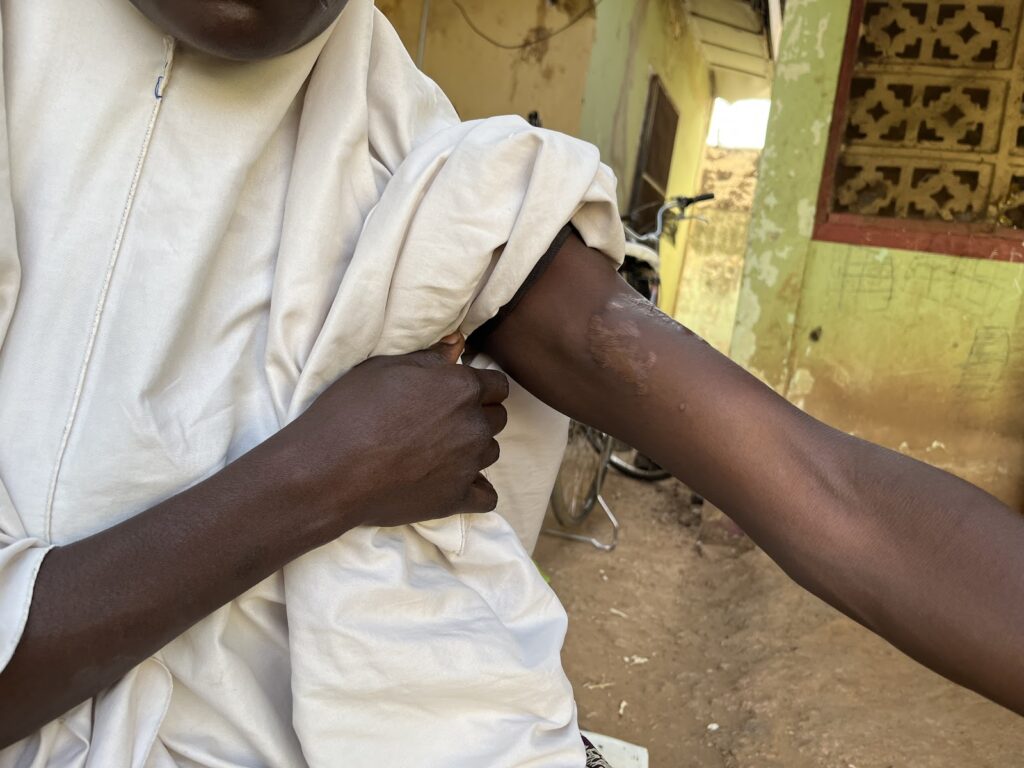
The first thing he did was to return to his family in the staff quarters to ensure they were okay. They were not. As he had first feared, the terrorists had found their way to the quarters after they were done in the boys’ hostel and set fire to houses. His house was no different. They had set fire to the house while his wife and daughters were in it. They all survived by finding their way out before it eventually ate its way through the entire building, but one of his daughters was caught in it longer than everyone. She sustained severe burns across her thighs, chest, and arms. Habiba
Habibashows the burns on her hand. Photo: Hauwa Shaffii Nuhu/HumAngle.
But Umar did not know this at the time. He had merely made sure they were alive and complete before hurrying off to the hostels to check on the boys. By then, residents of the town who lived nearby had begun to filter into the school, as well as some staff who survived. They all rushed to the hostel.
“What we saw when we got there was a litter of dead bodies. On the floor, on the walls, everywhere.”
“But there are no boys now. Only ash and screams and the flailing of arms.” — How Memory Unmakes Us, Gbenga Adesina.
Aftermath
The Buni Yadi massacre was done methodically. As the boys slept in their hostel, a section of the insurgents threw balls of fire under their bunk beds. That way, by the time they awoke or when the heat got to them, they would be jumping into the fire if they jumped off the beds.
As the children shouted for their lives as they burned, the terrorists taunted them. ‘Where are your soldiers? Let them come and rescue you.’
Some of them then stood outside windows, guns in hand, and gunned-down boys who tried to scale through the windows.
In this way, there were very few survivors.
“One would find up to five or six dead bodies outside one window. As they tried to jump out, they were being shot.”
When the military arrived at the scene after the attack, grieving staff of the school, angered by the slow response, asked where they were when they needed them the most. They responded that nobody had reported the attack to them while it happened. The response made many realise that the assurances they used to receive, that the military was on top of the situation, carrying out surveillance in their armoured tanks around the school every night to secure them, were false.
“Because if they had been truly doing that, they would have been aware of the attack. How could they have expected us to come to their barracks during the attack to report? The statement angered so many people that they nearly lynched the officer who made it,” a source who preferred to be unnamed said.
Soon, parents started to troop into the school to search for their sons after the news began to spread. On entering the school, they would find the dead bodies of the children, and many collapsed at the gory sight. Finally, after some time, the bodies were taken to the hospital and the mortuary, and those who were alive but wounded were taken into the emergency wards of the hospital for treatment.
Still, there were parents who did not hear about the attack for many hours because of the poor network connectivity in areas where the insurgents operated in those years.
Umar went along to the hospital with the bodies of his students. While there, news reached him that his own daughter back in the staff quarters was not well, so he hurried back to the school to meet his family. His daughter, Habiba, 19 at the time, was severely burnt.
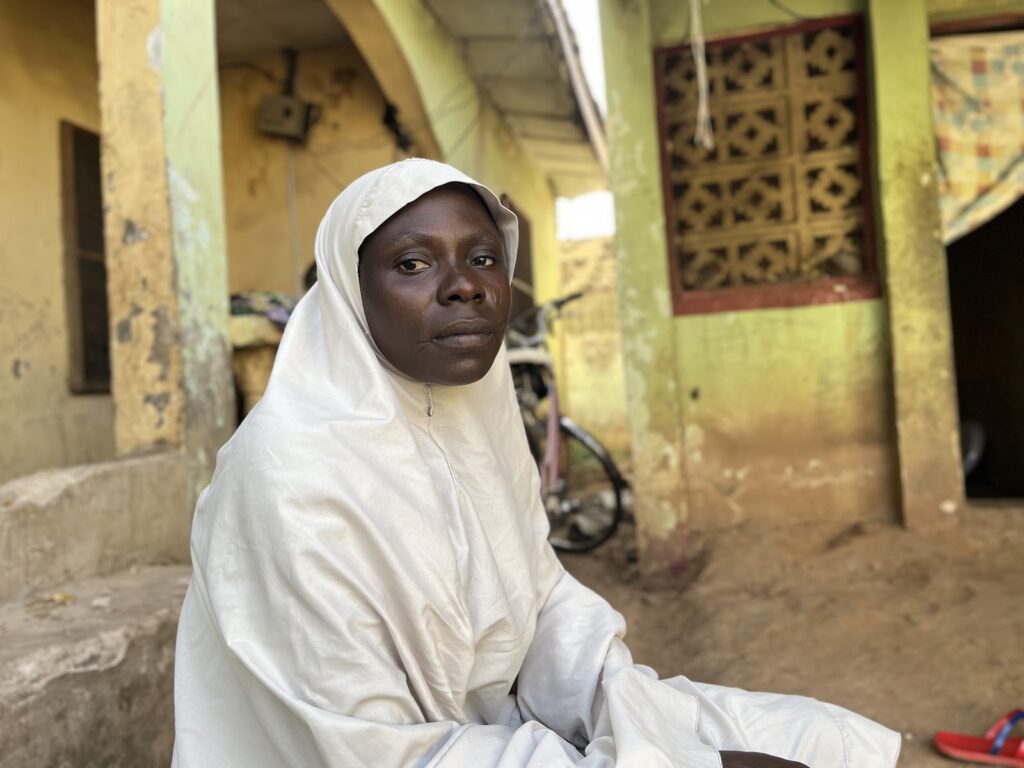
Habiba is now married with two kids. Photo: Hauwa Shaffii Nuhu/HumAngle.
She was lying down on the bare floor. He asked if she could sit properly, but she groaned that she could not. He was unsure how to proceed after that.
There were no vehicles left within the premises since they had all either been burnt or already used to convey the dead to the hospital.
“We had to look for a push-push [a trolley for water kegs] to convey her and others to the hospital,” he recalls.
Some of his other children could no longer see well due to the smoke they had to breathe in and be immersed in before they could break out of the building.
Luckily, treatment for them all at the hospital was free.
“At that time, the policy was that anyone in Yobe who was admitted to the emergency unit would be treated free of charge. The then governor, Geidam, had also directed all survivors of the attack to be treated for free.”
Not long after the attack, Umar moved his family away from Buni Yadi to Potiskum, Yobe state. The trauma was severe, and his residence had been burnt anyway. They also knew that the town had become more vulnerable to attacks. They turned out to be right because, not long after, the town fell to Boko Haram.
A persistent memory
When Malam Umar sat huddled and in hiding long after the insurgents had gone, he thought it would be an unending night. But after hours of hiding, after he had heard them driving away, silence slowly returned.
Then, he started to hear the call to prayer from far away.
The adhan came to Umar as a shock. Because he saw, then, that life was going on all over the world beyond that school compound, beyond the deaths and tragedy and horrors of the night. And that shocked him.
How was it that another day had come, and people in the next town could go about their lives?
“After all these things that just happened?”
Adesina’s poem ends with lines that echo Umar’s bewilderment.
“The unbelievable fact of history that the sun came out later that day.”
Hauwa Shaffii Nuhu is HumAngle’s Managing editor, and according to the newspaper she has her by-lines in several international publications and is a recipient of several fellowships and an award.
Kindly help us to grow by liking and sharing this story using the handles below👇
It is only in comparatively recent years that attention has been given to bee-keeping on a scientific basis. Aforetime there were certain traditional methods to be followed to secure the honey harvest, but those who practised them knew neither the why nor wherefore. Today, however, thanks to the observations of our great scientists on the life and habits of the bee, to their patience and diligence in noting the insect’s manner of working, we are in possession of knowledge which has enabled the practical bee-keeper to reduce the old haphazard ways to method, orderliness, and definite purpose.
The budding bee-keeper, as he reads one or other of these great works on the bee and its ways, may begin to wonder if it is not all too wonderful for him to deal with, and if he may ever hope to become proficient in the art and practice of bee-keeping. Let me say, here and now, that, given patience, perseverance, and diligence, a measure of success is open to anyone who brings intelligence into his work.
I’m spending more time with my family, exercising more, and getting more sleep.
Although the doubts and difficulties that assail the tyro, and the questions arising therefrom, might raise a smile from the expert—if only as a reminder of his own early aspirations and efforts—yet there is no reason for despair; though disappointments are certain to arise, they should be accepted merely as spurs to further effort, as steps towards the ultimate goal of success.
Some may think—rashly—that there is nothing new to be said or learned about the bee, but the fact is that even scientists are still ignorant as to the definite uses of certain of the insect’s organs, and of the origin and remedies of some of the diseases from which it suffers. Putting aside, therefore, the merely commercial aspect of bee-keeping, there is still a wide field of interest and research open for exploration by the intelligent bee-keeper.
It is only in comparatively recent years that attention has been given to bee-keeping on a scientific basis. Aforetime there were certain traditional methods to be followed to secure the honey harvest, but those who practised them knew neither the why nor wherefore. Today, however, thanks to the observations of our great scientists on the life and habits of the bee, to their patience and diligence in noting the insect’s manner of working, we are in possession of knowledge which has enabled the practical bee-keeper to reduce the old haphazard ways to method, orderliness, and definite purpose.
The budding bee-keeper, as he reads one or other of these great works on the bee and its ways, may begin to wonder if it is not all too wonderful for him to deal with, and if he may ever hope to become proficient in the art and practice of bee-keeping. Let me say, here and now, that, given patience, perseverance, and diligence, a measure of success is open to anyone who brings intelligence into his work.
Although the doubts and difficulties that assail the tyro, and the questions arising therefrom, might raise a smile from the expert—if only as a reminder of his own early aspirations and efforts—yet there is no reason for despair; though disappointments are certain to arise, they should be accepted merely as spurs to further effort, as steps towards the ultimate goal of success.
Some may think—rashly—that there is nothing new to be said or learned about the bee, but the fact is that even scientists are still ignorant as to the definite uses of certain of the insect’s organs, and of the origin and remedies of some of the diseases from which it suffers. Putting aside, therefore, the merely commercial aspect of bee-keeping, there is still a wide field of interest and research open for exploration by the intelligent bee-keeper.
It is only in comparatively recent years that attention has been given to bee-keeping on a scientific basis. Aforetime there were certain traditional methods to be followed to secure the honey harvest, but those who practised them knew neither the why nor wherefore. Today, however, thanks to the observations of our great scientists on the life and habits of the bee, to their patience and diligence in noting the insect’s manner of working, we are in possession of knowledge which has enabled the practical bee-keeper to reduce the old haphazard ways to method, orderliness, and definite purpose.
The budding bee-keeper, as he reads one or other of these great works on the bee and its ways, may begin to wonder if it is not all too wonderful for him to deal with, and if he may ever hope to become proficient in the art and practice of bee-keeping. Let me say, here and now, that, given patience, perseverance, and diligence, a measure of success is open to anyone who brings intelligence into his work.
Although the doubts and difficulties that assail the tyro, and the questions arising therefrom, might raise a smile from the expert—if only as a reminder of his own early aspirations and efforts—yet there is no reason for despair; though disappointments are certain to arise, they should be accepted merely as spurs to further effort, as steps towards the ultimate goal of success.
Some may think—rashly—that there is nothing new to be said or learned about the bee, but the fact is that even scientists are still ignorant as to the definite uses of certain of the insect’s organs, and of the origin and remedies of some of the diseases from which it suffers. Putting aside, therefore, the merely commercial aspect of bee-keeping, there is still a wide field of interest and research open for exploration by the intelligent bee-keeper.




 Bay States News