When it comes to commenting on political controversies, I am typically a hesitant participant. However, the current discussion around the Nigerian Vice President, Kashim Shettima, has struck a personal chord with me, compelling me to take a more active role.
Vice President Kashim Shettima has recently come under fire for his remarks about the equitable credentials of the President of the 10th Senate in Nigeria.
Shettima, a prominent northern Muslim politician, was criticized for allegedly denigrating his Muslim faith and promoting religious bias in his comments.
However, a closer examination of his statement and context reveals a different picture, one that is more nuanced and fair-minded.
Firstly, it is essential to note that Shettima’s statement was not made in a vacuum; instead, it was a response to the possibility and necessity of a southern Christian becoming the Senate President of the newly constituted 10th National Assembly. This position has become a non-negotiable right of the southern Christians, as per the default created after the 2023 presidential election.
In that context, Shettima said he would prefer a southern Christian, even if less qualified, than a northern Muslim perceived as more competent.
Of course this statement may sound controversial, but it is not without some merit.
Shettima’s point was that there should be some measure of balance and inclusiveness in the distribution of political power in Nigeria. He argued that it would be unfair for the Senate presidency, which is one of the top positions in the country – number two in the line of succession, to always go to the Christians in the South, especially as the President and his VP share the same faith.
In that sense, his statement was not meant to denigrate his Muslim faith but to promote fairness and diversity in political representation.
Moreover, it is worth noting that Shettima himself is a devout Muslim who has always respected his religion and its teachings. He has been a champion of education, healthcare, and humanitarian causes in his home state of Borno, ravaged by the Boko Haram insurgency and other forms of violence. He has also been a vocal advocate of peace, tolerance, and cooperation among different religious and ethnic groups in Nigeria. Therefore, it is improbable that someone of his calibre and stature would throw caution to the wind to make a statement that is deliberately offensive or divisive. He is too smart for that.
Some critics may argue that Shettima’s statement is still problematic because it perpetuates the notion of religious and regional quotas in politics. However, this argument misses the point that quotas are not necessarily discriminatory or unconstitutional if they promote diversity and inclusiveness and do not result in the exclusion and marginalisation of any group.
Some may argue that fairness should have been factored into the selection process for the presidential and vice-presidential flag bearers of his party. However, it is a fact that politicians are free to explore every legal avenue to win elections, including running with a ticket based on their shared faith. During campaigns, candidates are free to do what they need to do to win votes because if they lose, they bear the heavy burden of ridicule and regret alone. After the elections, the actions of the newly elected public officials are strictly guided by the laws of the land. Personal interests are no longer permitted to influence their decisions. This is when the importance of fairness and balance, in line with the nation’s diversity, is emphasised. This was precisely what the President and Vice President were prioritising during the selection process for the third and fourth highest leadership positions in the country.
In light of these facts, it is fair to say that Shettima’s statement, which is not even controversial, was not malicious or ill-intentioned. He spoke within the context of fairness and diversity, and he did not mean to harm or insult anyone. Therefore, it is important for Nigerians, especially northerners who may feel aggrieved or offended by his statement, to avoid twisting things and feigning ignorance about his good intentions.
British-American author and motivational speaker Simon Sinek once said that “feigned ignorance is a hallmark of the manipulator, and the sign of a deceiver,” even as America’s philosopher and poet TF Hodge, cautioned that “feigning ignorance may protect the ego, but it never leads to enlightenment.” The political leaders in opposition from the North should avoid promoting division or hatred by being disingenuous.
Nigerians, especially northerners, should avoid twisting Senator Shettima’s words and ignoring his good intentions. Instead, they should engage in constructive dialogue and debate the best ways to promote unity, progress, and justice in Nigeria.
Furthermore, it is essential to note that Shettima’s statement should not be seen in isolation from the broader political context of Nigeria. The country has been grappling with many challenges, including insecurity, corruption, economic inequality, and political instability. These challenges have often been exacerbated by ethnic and religious tensions, which have fueled violence and disunity. In that sense, Shettima’s call for balance and political representation should be seen as a positive step towards addressing these challenges and fostering national cohesion and development.
It is also worth noting that VP Shettima’s statement is not unique or unprecedented in Nigerian politics.
Many politicians and leaders have expressed similar views and preferences based on their interests, ideologies, and constituencies. However, what sets Shettima apart is his sincerity, integrity, and commitment to public service. He has proven himself to be a capable and compassionate leader who is dedicated to loyalty and supporting his principal, President Bola Ahmed Tinubu, in improving the lives of ordinary Nigerians, regardless of their religion, ethnicity, or social status. Nigerians, especially northerners, should give them the benefit of the doubt and avoid jumping to conclusions or making hasty judgments that promise nothing but division.
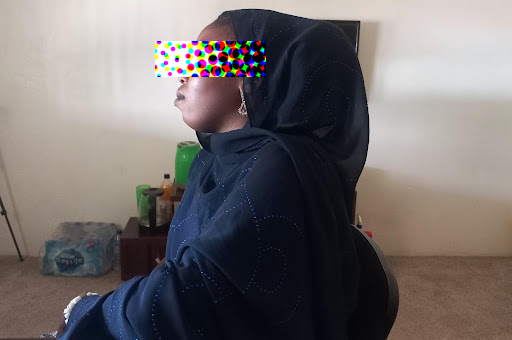
Hafsa’s harrowing experience of being abducted, abused, and forced into marriage by Boko Haram did not break her spirit. With unwavering determination, she escaped captivity, overcame stigma, and continues to fight for her future and that of her daughter.
With unwavering determination, she escaped captivity, overcame stigma, and continues to fight for her future and that of her daughter.
“He forced himself on me in the most brutal manner every night and would beat the hell out of me anytime should I dare to resist his advances for sex,” Hafsa Sale told HumAngle.
She is talking about her terrorist “husband”, the man who forced himself on her while she was a captive in the Sambisa Forest.
“It was two years of hell for me. I was bullied into remaining in that relationship with a beast who claimed to be my husband.”
Despite her traumatic experience, Hafsa Sale, 22, escaped from captivity and is now determined to move forward with her life. However, the memories of her ordeal continue to haunt her, and she fears they may never fully fade away.
Wearing a solemn expression, Hafsa, who is from Borno State, northeast Nigeria recounted the horrific abuse she suffered at the hands of Boko Haram militants during her two-year captivity in the Sambisa forest.
Journey interrupted
In November 2019, Hafsa had attended a family funeral in Kaduna. The journey back to Maiduguri in Borno state, was long and tiring.
The car journey was about to be interrupted at a village called Ngamdu, 100 km short of her destination.
As they approached Ngamdu, the driver had to slow down due to a rough patch of road, and that was when they saw the armed men. The driver attempted to speed through the group standing by the roadside, but the gunmen opened fire.
“Our vehicle nearly skidded off the highway as a bullet hit the driver in the head,” Hafsa narrated. “I don’t know how the car managed to stop because the driver, whose head was blown off, was already dead.”
The assailants dragged the driver’s body out of the car and left it by the roadside. One took over the wheel and drove the vehicle into the bush, while the others followed on their motorcycle. Hafsa was left traumatised by the harrowing experience, highlighting the ongoing security challenges many people face in Nigeria.
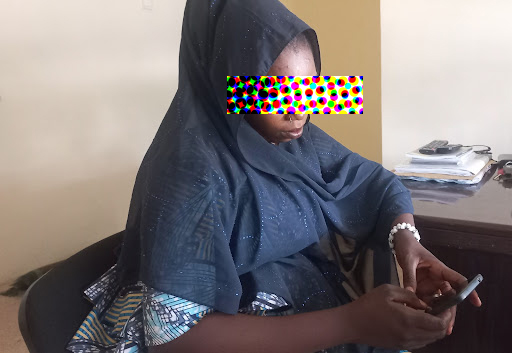
Hafsa checks her daughter’s photo on her mobile phone. Photo credit: Abdulkareem/HumAngle
After four days of travel, they finally arrived at Sambisa and were confined to a house by their captors. The kidnappers demanded that they provide phone numbers of their relatives and friends back home, promising to call them and request ₦2 million each in exchange for their release.
“They made it clear to us that any involvement of security operatives would result in severe consequences,” she recalled.
Police ambush
Initially, the victims believed that the kidnappers were just ordinary criminals. Some women even made the calls and got the money.
One of the women’s husbands was a police officer who then informed his colleagues about their situation.
The police secretly went with the people who had the ransom money to where they were supposed to meet the terrorists. When the kidnappers let the hostages go and took the money, the police shot at them and killed many. They also got back the money and the motorcycles that belonged to the kidnappers.
Back at the camp, Hafsa had assumed the role of guardian for the children. “I was the oldest person left,” she said.
However, one day, the Boko Haram terrorists dragged out the most senior boy, Kamala, and brutally murdered him in front of the captives.
“His crime was that he refused to convince his siblings to accept the Boko Haram ideology,” Hafsa explained.
After the police ambush, some of the surviving terrorists began to blame Hafsa for the deaths of their colleagues.
“So, they began to whip me every day until they got tired after some days,” she recounted.
“Should I pull off my dress?” she asked HumAngle. “You could still see the deep scars of the whipping on my back.”
Sadly, the boys left Hafsa’s custody and soon became radicalised. They joined Boko Haram as fighters.
“The boys, whom I cooked food for daily, began to threaten my life because I was unwilling to accept the Boko Haram creed,” she continued.
One day, they came to her hut and threatened to kill her if she refused to marry one of their commanders.
“I saw the devil in their eyes, and I had no option but to succumb to the marriage,” she said in tears.
The abuse
The Boko Haram commander Hafsa was forced to marry was known as Abu-Hanif.
“Months into the marriage, I became pregnant but later had a miscarriage due to Abu-Hanif’s violent behaviour,” she said. “Despite my condition, he continued to engage me in forced sexual intercourse until I became pregnant with my daughter.”
After giving birth, Hafsa attempted to escape one night during a rainstorm when the men had gone out to fight.
She ran until she reached one of their checkpoints, where some of the terrorists were on guard. They caught her and forced her back.
“They shackled my legs and left my baby and me in the house,” she said.
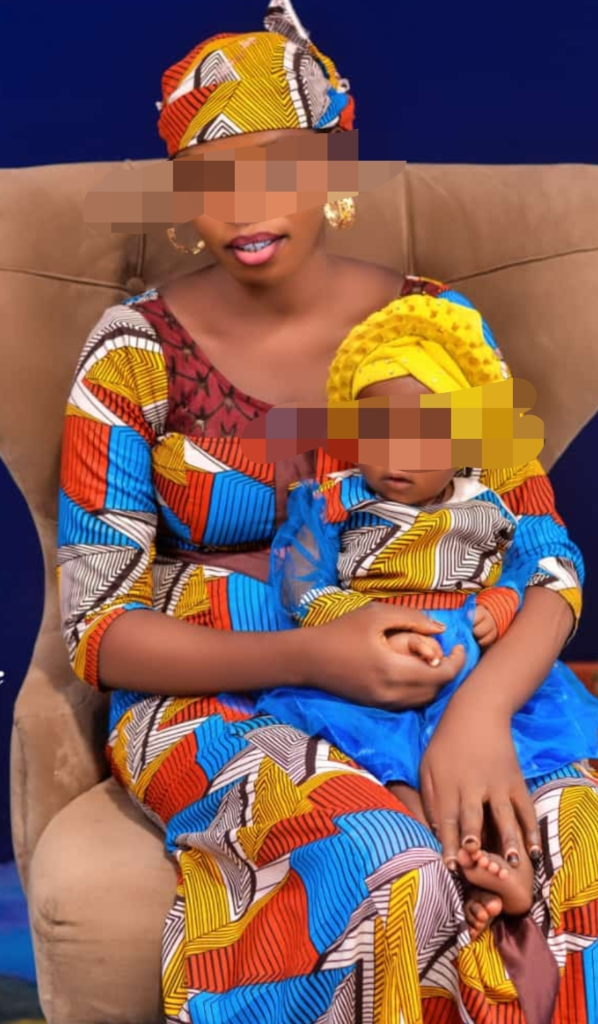
Hafsa and her daughter, Maryam, during a recent Eid celebration. Photo Credit: Hafsa Sale
Bound in chains, Hafsa suffered captivity for three long months until she finally found the courage to break free and attempt another escape. Before her second attempt, she managed to gather valuable information about potential escape routes from friendly and unsuspecting members of Boko Haram whom she had worked to build a rapport with.
Despite the immense risk involved in her plan, Hafsa’s determination to regain her freedom pushed her to take the necessary steps toward a successful escape. She knew the road ahead would be tough, but armed with the knowledge she had gathered and fueled by a fierce desire for freedom, she set out.
“They informed me that there were three potential routes leading out of Sambisa from our current location,” she recalled.
“The first route led to Bama, the second led to Gwoza, and the third, which was undoubtedly the easiest, led to Pulka village.”
One fateful night, Hafsa took the route to Pulka with her child strapped to her back. The journey was tough, taking them nearly four days to reach the village’s outskirts.
“As we approached, I had to remain vigilant, hiding whenever possible to avoid detection,” she said.
Farmers working in the area spotted her, and they immediately alerted the nearby military post upon seeing her. She later learned they were suspicious because she was holding something under her hijab. That something was her baby.
So the soldiers were apprehensive when they approached her, fearing she might be a female suicide bomber. It took some time for her to convince them that she had just escaped from Sambisa forest and what she had under her clothes was her child.
“Despite her explanations, the soldiers remained sceptical and demanded that she prove her innocence.
“I was forced to strip naked to confirm that I was not an enemy combatant. The soldiers were eventually satisfied that I posed no threat, but the incident left me traumatised and deeply shaken because they were all pointing their guns at me.”
The soldiers took mother and daughter to the Pulka IDP camp, where they were provided with warm water to bathe and food to eat.
“Eventually, we were relocated to Bama, where I could recharge my mobile phone, which I kept hidden in my travel box or sometimes under my brazier.”
Hafsa said she treasured that phone because she hoped she would one day escape and use it to call her relatives.
“The phone’s battery had died, but luckily, boys in Bama offered to charge phones for a fee. They boosted my phone’s battery, and I was overjoyed to call and speak to my dear mother.”
The experience of being able to speak with her family after months of captivity was emotional and overwhelming.
“It was a reminder that I was not alone in my struggles and that my loved ones were still waiting and hoping for my safe return,” she said.
Living with Abu-Hanif
Hafsa recounted that the man who fathered her daughter was cruel and abusive. He had no compassion or sympathy towards her and had subjected her to constant physical and emotional abuse during their time together. She could only recall a few instances where he had spared her from his violent outbursts.
Sometimes he withheld food from her for not adhering to his religious beliefs. And then, when it came to sexual intercourse, he showed no regard for her feelings and would often resort to physical violence before forcing himself upon her. Tragically, Hafsa lost her first pregnancy at just four months due to the abuse she endured.
According to Hafsa, the terrorist-husband frequently referred to her as an infidel and treated her with unspeakable cruelty, as if she were subhuman.
When she eventually made it to Bama, Hafsa came in contact with other women who had also fled from Sambisa. They informed her that the man responsible for her suffering, Abu Hanif, had died during the last operation they had gone on before Hafsa’s escape.
Some months before she left, the group had split into factions. Her former tormentor had been with those who broke away and formed the Islamic State of West African Province.
The news relieved Hafsa, but the trauma of her past experiences continued to haunt her. She was determined to move forward and reclaim her life, but the scars of her past would remain with her for years to come.
“I was delighted to hear that he was killed in a fight with a rival group of Boko Haram. He was on the side of ISWAP,” she said.
“I am happy that he is not alive or among those who are surrendering today in Maiduguri. His being alive would have tormented me for life.”
Hafsa recalled that in Sambisa, the cost of paying the bride price and conducting a brief wedding ceremony at the mosque to consummate the marriage is only ₦3000 (about $6). She explained that Boko Haram considers elaborate wedding ceremonies and fanfare sinful.
“To avoid drawing attention, marriages are conducted quietly, with only the men congratulating the groom after the dowry is paid,” Hafsa said.
In the evening, two or three older wives of Boko Haram leaders would accompany the “bride” to her home – a mud house covered with bare corrugated iron sheets, mainly under trees to evade detection by military aircraft.
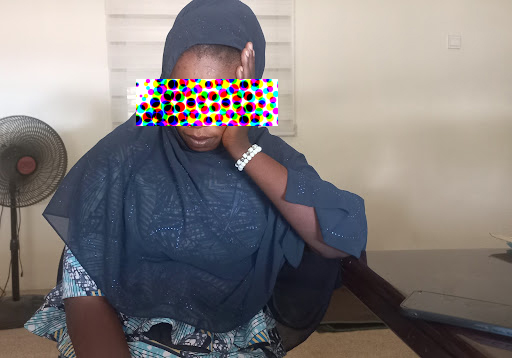
Hafsa says she is determined to give her all to her child. Photo credit: Abdulkareem/HumAngle
Returning home with a child
Hafsa had to plead with the camp officials to let her go home and see her family after spending weeks at the Hajj Camp rehabilitation centre. Initially, the officials did not believe she had a family in Maiduguri until her brother came to the camp to confirm her story.
Once she was allowed to go home, her friendly nature drew many visitors and supporters to their house. However, upon seeing her physical and health condition, many of them broke down and cried.
Shortly after, Hafsa fell ill and was hospitalised for several days. The doctors had to administer four pints of blood before she could recover from the strange ailment that had befallen her. Throughout her illness, Hafsa was terrified about her daughter’s fate should she die.
But after Hafsa’s recovery came another challenge – handling stigmatisation outside her home. She had to learn to stand up when anyone tries to denigrate her or mock her daughter. She also constantly reminded herself that she was not responsible for what befell her because anyone could be a victim.
“I am a fierce survivor, and I even had to fight the wives of Boko Haram who dared to come and mock me in Sambisa. Yes, out there, I was wild and fearless, and I even beat up two women who called me an infidel,” she said.
Although this later earned her a severe beating for daring to fight the wife of one of their commanders, Hafsa eventually earned their respect. “They avoided causing me trouble after that, and I could live peacefully.”
Moving on
Hafsa said she is no longer ashamed of her circumstances and is not afraid to confront anyone who tries to say anything nasty.
“I’ve told them that I will not be apologetic about what happened to me because they, too, are not immune to being a victim.”
She added: “I hate and detest the man who fathered my daughter, but my daughter is my world. I am determined to bring her up as a proud, confident, and happy child.”
At the moment, Hafsa lives in a neighbourhood where people lack education on trauma and dealing with survivors of armed violence. Her mother and childhood friend have been her primary source of support. Her friend takes care of her daughter and never gives up on her. This and more has kept her away from mental illness.
One other significant part of the support system is the constant love she gets from her boyfriend, who remained dedicated after her return. He eventually proposed marriage, and although Hafsah hesitated due to her past, she later agreed.
Since her return home in Nov. 2021, Hafsa has focused on taking care of her child. Having lost contact with her for many months, Hafsa’s family had given up on ever seeing her again, leading them to give away most of her personal belongings, including her school credentials. She had seven credits in her West African Examination Council (WAEC) result.
Before her abduction, she had planned to pursue her dream of becoming a nurse by enrolling in the College of Nursing and Midwifery. Despite this setback, Hafsa intends to work and provide for her daughter until she can afford to return to school.
Lifeline
Hafsa was recently supported by a Maiduguri-based NGO, Allamin Foundation, to learn how to produce liquid soap, petroleum jelly, room fresheners, and toilet disinfectants. After completing the two-week skill acquisition programme and receiving a starter pack from the NGO, she started a successful business.
She expressed gratitude to the foundation, stating that the business skill she gained will help her save for her daughter’s education.
“Besides my family’s moral support, I have not received any empowering support from anyone. With my mother getting older and our father passing away years ago, I am a single mother with no one to rely on. However, the newfound skill I have acquired has made me independent and empowered,” she said.
Hafsa has since been making brisk sales promoting locally-made detergents and room fresheners on her social media handles. People patronise her products, mainly through her WhatsApp profile page, where she often posts photographs. She also delivers her products to retail shops at discounted rates to help them make a quick profit.
When Hafsah is not running her own business, she works shifts as a fuel pump attendant at a local filling station near her home.
This breathtaking piece of journalism was published initially by HumAngle
Back in September 2009, many Nigerians, particularly Muslims, were left astounded when a man contradicted the date declared by the Sultanate of Sokoto for observing the end of Ramadan moon – and the man’s alternative prediction turned out to be correct.
The man in question was none other than Mr Salisu Zubairu, who was convinced that the 2009 edition of Ramadan would last for 29 days instead of the previously announced 30 days by the country’s Supreme Council on Islamic Affairs. And true to his word, that was exactly what happened.
While the Supreme Council on Islamic Affairs probably relied on human judgment, Mr Zubairu relied on science. He used the calculations from his revolutionary telescopic invention, the ‘4x60mm Zubairu Calibrated Telescope,’ to accurately predict the end of Ramadan.
Mr Zubairu’s groundbreaking invention offered a fresh perspective on traditional methods that relied on human judgment, which could sometimes be susceptible to errors. His use of science and technology showed how a well-calibrated instrument could provide more reliable and accurate results.
Mr Zubairu’s achievement highlighted the importance of using science and technology to complement traditional methods to achieve greater accuracy and precision in various fields. His contribution to the scientific community will undoubtedly inspire future generations of scientists and innovators in Nigeria and beyond.
Although Mr Zubairu’s counter-views to the Sultanate’s declarations were offensive to many good Muslims who revered the Sultanate, they were unaware of the extensive research and development he had conducted over many years. He used his technology to arrive at authoritative conclusions that challenged traditional observation methods.
Mr Zubairu’s Book Nowsold out on Amazon
Mr Zubairu’s ‘4x60mm Zubairu Calibrated Telescope’ was instrumental in fabricating a rare kind of Lunar Tracking Clocks that he used to prove that one full circle of the lunar movement against the Gregorian calendar completes in 33 years. His findings were original and groundbreaking.
Explaining his discovery, Mr Zubairu said, “I was able to discover perfectly that in 33 years, the days of the lunar movement Mrifted gradually and returned to where it started.”
While Mr Zubairu’s findings were met with scepticism at first, his groundbreaking research and technological advancements proved to be a turning point in the way lunar movements were observed and predicted. His discovery has paved the way for more accurate and reliable predictions of lunar movements. It has inspired a new generation of scientists to explore the possibilities of using technology to complement traditional observation methods.
Mr Zubairu’s discovery has significant implications for the study of lunar movements. He says, “This discovery signifies that the lunar movement against the earth, even if they scatter in their trajectory, always returns to the same position after 33 years. I’ve gotten so many findings in my research on the lunar movements, which are novel and original. And this has never been researched anywhere in the world.”
Mr Zubairu’s groundbreaking research on lunar movements has revealed a harmonic Mrift in lunar dates against the Gregorian calendar. His findings challenge traditional observation methods and have paved the way for more accurate and reliable predictions of lunar movements.
The technologist’s work has been recognised internationally. He explained, “I sent my findings to an international journal for a review, which came back as original work; ‘no recent work was sighted at that time’.”
His research and technological advancements have transformed how lunar movements are observed and predicted. His discovery has inspired a new generation of scientists to explore the possibilities of using technology to complement traditional observation methods. His contribution to the scientific community will undoubtedly have a lasting impact.
Mr Zubairu Salihu, a multi-talented Nigerian scientist and technologist from Adamawa state, has made significant contributions to the field of lunar telescopy. Based at the University of Maiduguri, he discovered a discrepancy between the lunar and Gregorian calendars that causes the lunar calendar to Mrift over time. This discrepancy, known as harmonic Mrift, has important implications for the Islamic calendar, particularly for the timing of Ramadan.
Mr Zubairu is a senior technician at the Physics Department and an active researcher who has published several papers in international scientific journals. His work on the lunar calendar has garnered widespread attention and media coverage.
His groundbreaking research has shed light on the discrepancies in the lunar calendar and has paved the way for more accurate predictions of lunar movements. His contributions to the scientific community have been invaluable. He explained, “I have always been passionate about science and technology, and I am glad that my work on the lunar calendar has been recognised internationally.”
Mr Zubairu’s achievements have inspired a new generation of scientists and technologists in Nigeria and beyond, and his legacy will undoubtedly have a lasting impact on the field of lunar telescopy.
The Islamic calendar is a lunar calendar that relies on the moon’s cycles to determine religious observances. However, because the lunar month is shorter than the solar month, the Islamic calendar doesn’t align with the Gregorian calendar. To address this difference, the Umm al-Qura calendar uses astronomical calculations instead of actual moon sightings and is utilised by the Saudi Arabian government to determine Islamic holiday dates.
Despite the Umm al-Qura calendar’s use of astronomical calculations, it still experiences some drift over time. Mr Salihu’s research reveals a secondary Mrift in the lunar calendar caused by the harmonic interaction between the moon and the Earth. Although smaller than the primary Mrift, the secondary Mrift is still significant over extended periods.
Mr Zubairu’s discovery has significant implications for the Islamic calendar, particularly in determining the timing of Ramadan, the month of fasting in Islam, determined by the sighting of the new moon. Because the lunar and solar calendars do not align, the start of Ramadan can vary up to two days annually, causing confusion and uncertainty for Muslims worldwide who rely on the lunar calendar to determine religious ritual timing.
The UNIMAID wizkid’s research on harmonic drift offers a potential solution to the problem of the lunar calendar’s drift. By accounting for the secondary drift, it is possible to evaluate the lunar calendar using a scientific approach. This involves determining the possible first lunar location above the western horizon approximately 30 minutes after sunset, which is the reference location and time.
Mr Zubairu’s recently published research, “Scientific Observation of Harmonic Drift in Lunar Dates Against Gregorian Calendar,” available on Amazon, reveals that existing lunar calendars are primarily based on numerical differences resulting from the discrepancy between the Islamic and Gregorian calendars. Mr Zubairu’s work on harmonic Drift provides a more accurate and scientific approach to evaluating the lunar calendar.
In the published project, Zubairu, an Ophthalmic Optics graduate from Temple University Philadelphia, emphasized that the “Harmonic Drift in lunar dates against the Gregorian calendar is noticed as a secondary Drift and possible cause of the discrepancy in the lunar calendar.”
In his published project, Zunairu, a graduate of Temple University Philadelphia in Ophthalmic Optics, highlights the importance of the “harmonic Drift in lunar dates against the Gregorian calendar.” This secondary Drift is a possible cause of the discrepancy in the lunar calendar. It has aided in developing a more reliable lunar calendar capable of projecting dates for extended periods without differences.
Zubairu hopes his published work will excite individuals and organisations interested in astronomy, including educational institutions and research centres.
Who Is Mr Zubairu Salisu?
The 65-year-old technologist, Zubairu uniquely understands the harmonic Drift in the lunar first-of-its-kind Gregorian Calendar. However, this is not his first discovery. He has also fabricated binoculars, sniper lenses, a first-of-its-kind lunar-tracking clock, and a space observatory using locally sourced materials. Zubairu’s expertise in lunar reading has made him Nigeria’s walking encyclopedia in lunar tracking. He has multiple talents that go beyond his original field of Ophthalmic Optics, including manufacturing various lenses for military and space-related viewing.
In 1988, Zubairu, then 29 years old, gained recognition for creating binoculars using locally sourced materials. The Federal Ministry of Science took notice and invited him to present before a presidential brain Drain committee on science. Journalist Nosa Igiebor wrote about Zubairu’s invention in the May 1988 edition of Newswatch magazine, stating that he “has made a pair of binoculars, magnifying glasses, a convex mirror and a microscope. And now Zubairu has designed an astronomical telescope. But then he did not have the facilities to make the device.” Despite his achievements, Zubairu could not obtain financial backing or sponsorship from the Nigerian government to pursue his Dream.
“I have visited the Project Development Agency (PRODA), Enugu, and the Federal Ministry of Science and Technology. But they kept asking me to come back again,” said Mr Zubairu, according to the Newswatch magazine. Following the publication, Zubairu was invited to present his work at the Federal Ministry of Science and Technology. He met Professor Madu Mezia, a renowned physics professor and Special Assistant to the then Minister of Science and Technology, Emmanuel Imovon. During the Babangida regime, Zubairu could attend meetings with Professor Alele Williams as part of a federal government science committee named ‘the presidential Brain Drain Committee.’
Zubairu presented his work before the committee and impressed everyone in attendance. Professor Awele Madu Mezia was particularly impressed and shortlisted him to be a member of the Sheda Science Village in Kwali, Abuja, where indigenous scientists and inventors develop their skills. However, Zubairu did not receive an official letter to report to the centre because it lacked equipment for optical science and instead only invited talents in engineering.
“I was among the first list of persons to be shortlisted to be at Sheda Science Complex, from where we were supposed to travel to Germany for some training. But unfortunately, I did not get the official invite; so others went to Germany, and I was never called again.
The Nigerian government failed to support Zubairu’s skills even after 35 years since he created these scientific tools, which Nigeria still imports from abroad. Zubairu, now 65, believes it is not too late for the government to support his project, but he also worries about time running out.
Zubairu currently works as a Lead Technologist at the Department of Physics at the University of Maiduguri. He obtained his first degree in Ophthalmic Optics from Temple University in Philadelphia and returned to Nigeria in the early ’80s to work at Isijola Optical Service in Lagos. In 1992, he declined an offer to work as a lead Ophthalmic Optician at the University of Maiduguri Teaching Hospital. Instead, he was appointed as a Lead technologist in the physics department at the same university.
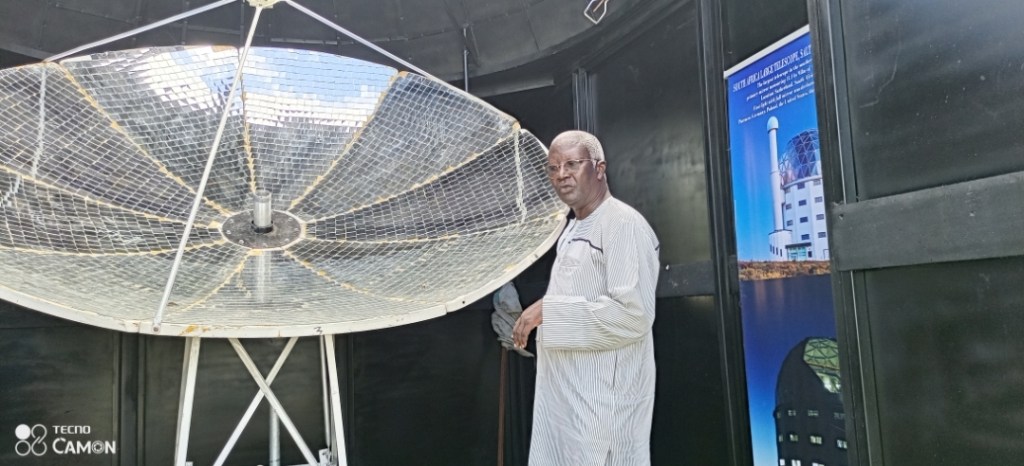
Zubairu at the site of one of his most ambitious projects – space observatory
Mr Zubairu leverages his position in the physics laboratory to continue his research and development in optical science and telescopic lenses, leading to the successful creation of 4x40mm Binoculars. Despite his achievements, Nigeria and other African countries cannot produce binoculars, a technical knowledge Zubairu demonstrated over three decades ago.
Zubairu finds it ironic that Nigeria still cannot produce basic instruments like binoculars, telescopes, and sniper lenses, despite how easy it is to do so. He remarked, “It is funny to note that until now, Nigeria does not produce basic instruments like binoculars, telescopes, and sniper lenses, even though it is very easy to do so.”
Mr Zubairu refused to let the Nigerian government’s cold attitude dampen his inner fires of creativity and research and continued exploring various astronomy fields using his locally fabricated lenses. He further improved his first binoculars, the 4x40mm ZB, and sent a letter to the then Chief of Army Staff, General Alwali Kazir. Impressed by his work, General Kazir invited him to present it before an army council at the Army headquarters.
During the presentation, Mr Zubairu showcased his capabilities and spoke about infrared technology. He explained the core components of infrared and how it could support the military in tackling the challenges of fighting at night. He further highlighted that they had the idea and skills to develop their infrared facility for rifles, binoculars, flying jets, and other long-range targeting weapons.
According to Mr Zubairu, the army council approved his proposal, and some funds were released to start work on night viewing instruments, including the infrared and light intensifier. However, with the appointment of General Ishaya Bamaiyi as the new Chief of Army Staff, the project was terminated, as he did not appreciate its significance.
Fortunately, General TL Ashei, the Chief of Army Policy and Plans at the time believed in the project and gave Mr. Zubairu a letter of referral to the Federal Ministry of Science and Technology, ensuring that the project did not die naturally. The late General Sam Momah, the Minister of Science and Technology at the time, was interested in the project and directed Mr Zubairu to proceed to the Science Equipment Development Institute (SEDI) in Enugu. He received a recommendation from the institution to the minister on the need to sponsor the project.”
After a few months, Mr Zubairu received approval for the project, and a cheque was issued. However, the cheque was made to SEDI, not Zubairu, with a cover letter stating that the funds were meant for him and not the institution. Mr Zubairu planned to work through NASENI, a federal government agency that oversees all centres involved in engineering projects.
Despite receiving the funds, Mr Zubairu faced several challenges during the project’s development. He was frustrated by SEDI’s lack of support. They did not engineer or produce the body for him, despite him designing the infrared device and light intensifiers and acquiring all the required lenses. Consequently, he wrote a report to inform the ministry of the setback, but they have not responded since then.
Mr Zubairu returned to his work at the University of Maiduguri, designing and fabricating prototypes of refracting astronomical telescopes and sniper telescopes for rifles. In 2004, he was introduced to Major General Edo Wande, the Director-General of the Defence Industry Company of Nigeria (DICON), who invited him to design and construct a prototype of a C2-sight for an 88mm mortar gun. Although Mr Zubairu submitted the prototype within four months, no further development occurred. His work was later featured at the 2004 NUC research exhibition in Abuja, and some military generals appreciated his work. However, upon returning to Maiduguri, he encountered military problems.
“After the exhibition, I returned to Maiduguri and was sought out by military intelligence operatives who had received a signal from their Director MI about my project. They wanted to see my snipers’ prototypes and had initially intended to harass me. However, after I visited the barracks and explained that universities worldwide teach all kinds of gadgets, military and civil, they became interested. Unfortunately, the General who had taken an interest in my work retired, and nothing came of it.
A shift to lunar telescoping
Mr Zubairu concluded that the Nigerian military was not interested in his work, despite his efforts to show them how his projects could help solve their non-ballistic hardware needs. Frustrated, he put his quest to design sniper rifle telescopes aside and shifted his focus to creating telescopes for lunar movement instead. His experience with the military taught him that critical projects often depend on the interest or passion of a single individual. Once that person is no longer in charge, the project dies because there is no institutional interest or framework to sustain it, according to Mr Zubairu.
Uncertain of his next steps, Mr Zubairu shifted his research focus toward designing telescopes for lunar movements. Through his work, he was able to calibrate a telescope that accurately monitors the moon’s movements, allowing him to create a calendar based on the Islamic lunar cycle.
After nine years of painstaking work, he could tabulate the calendar for a 33-year cycle. He had to enter each suggestion into the columns one by one manually, and by the time he reached the 33rd year, the suggestion returned exactly where he had started – this was the furthest he had gone in lunar research.
According to Mr Zubairu, his findings are original, which is why the Saudi Arabian journal, Astronomic, was interested in publishing them. Despite not receiving recognition in his home country, Mr Zubairu’s book is now available on Amazon’s online marketplace.
In the future, this newspaper will explore another ambitious project by Mr Zubairu in space observation science. This project is currently in progress at the UNIMAID Campus.
Once upon a time, there was a beautiful lake that was a haven for fishermen.
The locals would cast their nets and spend their days on the water, catching fish for their families and community.
The lake was a source of joy and sustenance for all who lived nearby and those who journeyed from afar.
But over time, things began to change. The fish in the lake began to disappear, and the fishermen struggled to make ends meet—no thanks to human interference and altering climate.
Desperation set in, and some turned to more extreme measures to survive.
Suddenly, the lake became a breeding ground for terrorism. Where fishermen would cast their nets and drag out fish now become up a dragnet for violent extremism.
Extremist groups set up shops, using the area as a base to plan and carry out acts of violence. The peaceful hinterlands of Baga, Krenoa, Kauwa, Monguno, Malamfatori, Mobbar, Ajigin, Dikwa, Bama, Kondu’a, Gwoza, Mafa, Ka’a, and a host of others were suddenly plunged into chaos and fear, as no one felt safe anymore. Everyone fled.
The government and security forces stepped in to try and restore order, but it proved to be a difficult task. It is 14 years now. The terrorists are unyielding and have already gained a foothold and wielded significant power.
It seemed like the lake would forever be associated with fear and violence. Many Generals have come and gone, yet, the war still rages on. Sometimes hot, sometimes cold. But for each undulating temperature, lives are lost.
And so, the once-beautiful lake remained abandoned, no longer a significant source of fish but a grim reminder of how desperation and violence can take hold in even the most idyllic of surroundings.
Haruna, a seasoned journalist working in the Lake Chad region, is our guest writer.
The International Fund for Agricultural Development (IFAD) has announced that it has invested a total of $604.6 million in Nigeria’s agricultural sector, providing support to farmers and facilitating sustainable agricultural development in the country. The investment was made through domestic and international co-financing between the years 2016 and 2023.
According to Mr. Abdulhameed Girai, the Monitoring and Evaluation Adviser, FGN/CPAT-Country Programme Advisory Team, over 5 million people across 28 states of Nigeria have benefited from viable interventions initiated by the program. The beneficiaries were under IFAD’s Country Strategic Opportunities Programme (COSOP) in the past seven years.
Speaking at a two-day regional consultative workshop for Nigeria’s 2024-2029 project in Maiduguri, Mr. Girai highlighted some of the programs that IFAD has supported, including the Value Chain Development Programme (VCDP), the Livelihood Improvement Family Enterprise Programme (LIFE-ND), and Special Agro-Industrial Processing Zones (SAPZs).
The investment by IFAD in Nigeria’s agricultural sector is aimed at addressing the challenges faced by smallholder farmers and ensuring food security in the country. By providing viable interventions and support to farmers, IFAD aims to encourage sustainable agricultural development and create opportunities for rural communities.
Armed terrorist groups killed 44 civilians in two villages in northeastern Burkina Faso, near the Niger border, according to regional governor Rodolphe Sorgho.
The attacks took place overnight Thursday in the villages of Kourakou and Tondobi in the Sahel region. Sorgho reported that 31 people died in Kourakou and 13 in Tondobi.
The lieutenant-governor described the killings as a “despicable and barbaric attack”.
The army launched an offensive against the attackers, Sorgho said, and “actions to stabilise the area are under way”.
Last June, 86 civilians were killed close to the village of Seytenga in one of the worst attacks of an ongoing insurgency.
The impoverished Sahel country of Burkina Faso is facing a seven-year-old jihadist insurgency, with attacks by groups linked to Al-Qaeda and the Islamic State increasing in recent years.
In response to the recent attacks, the country’s new military chief, Colonel Celestin Simpore, vowed to step up a “dynamic offensive” against the armed groups.
Regional governor Rodolphe Sorgho also called on the local population to join the Front for the Defence of the Fatherland (FDS), a pro-junta movement, and enroll in the VDP volunteer militia.
The twin attacks that killed 44 civilians on Thursday happened close to the village of Seytenga, where 86 people were killed in one of the deadliest attacks of the insurgency.
Sorgho said that “actions to stabilize the area are under way”.
President-elect Asiwaju Bola Ahmed Tinubu has condoled the family and colleagues of the National Welfare Officer of the All Progressives Congress (APC), Friday Nwosu, who died Thursday evening in Abuja.
Late Nwosu was until his death a leader of the party in Abia State and a member of the National Working Committee (NWC) of the party.
In a statement by his media office on Friday, Asiwaju Tinubu said Nwosu’s death had left a gaping hole in the party.
“I received with shock and grief the news of the sudden death of Chief Nwosu. He was a dedicated party man and a leader who paid his dues for the success of the party.
“I join friends and family in grieving this sudden loss of a man who had worked so well for our great party. His sacrifices and contributions to the growth of democracy and our party will be cherished for a long time,” he said.
The president-elect prayed for the soul of the deceased and for God to grant succour to his famiky.
Abdulaziz Abdulaziz Office of the President-elect March 10, 2023
Culture of Silence Fueling SGBV in Northeast Nigeria – CDD
The Center for Democracy and Development (CDD), a non-governmental organisation, has identified silence as a major bane towards eradicating Sexual and Gender-based Violence (SGBV) in North-East.
CDD Gender Adviser, Dr Amina Nur-Alkali stated this on Wednesday in Maiduguri at a one-day community sensitisation organised to mark the 2023 International Women’s Day.
The 2023 IWD theme is “DigitALL: Innovation and technology for gender equality”.
Nur-Alkali said that women were unwilling to speak out about their experience, adding that, “the victims are being blamed, denied help or told to stop talking.
“This will further amplify brutal physical and psychological consequences for survivors as they are exposed to trauma, stigma, and as a result denied justice”.
According to Nur-Alkali, the CDD programme is designed to create awareness on SGBV, discourage the culture of silence, reduce stigma and enhance access to justice for survivors.
Also speaking, the Coordinator, National Human Rights Commission (NHRC) in Borno, Jummai Mshelia expressed concern over the inability of government at all levels to domesticate gender and equality law.
She said domestication of the gender and equality law would reduce SGBV in the society.
Mshelia advised women to seek justice through relevant authorities when their rights are violated.
For her part, Mugwa Kambasha, Chairperson, Stand Up for Women Society, advised victims of SGBV to keep evidence to hasten prosecution of offenders.
“The first step, is to take survivors to hospital and in doing that they should not do it all alone, they should also go with the police.
“After clinical analysis, it is the duty of the police to forward the case to the Criminal Investigation Department (CID).
“The corganisation will pursue the case to logical conclusion, we go to court to ensure that women get justice,” she said
In a statewide broadcast, Governor of KadunMalam Nasir El-Rufai, Governor of Kaduna State, 16th February 2023.
My dear people of Kaduna State,
With just about 100 days before leaving office, and elections just round the corner, it was my intention to host another media chat to interact with the people of our state in the next few days. While I still hope to do so, I feel the need to address you all today due to the unprecedentedly cruel situation our people and their livelihoods have been thrown into, particularly in the last two to three weeks by the decisions, actions and inactions of the Federal Government of Nigeria.
On behalf of the government of Kaduna State, I wish to express my deepest regret at the needless suffering you are enduring as a result of the prolonged fuel shortage and the difficulties occasioned by the so-called “currency redesign” policy of the Central Bank of Nigeria. We understand your pain. I assure you that as your State Governor, I have been working with my other colleagues to do everything in our power to end these pains.
While publicly supporting what appeared to be a beneficial policy, we innocently engaged privately with the President and the leadership of the Central Bank of Nigeria to review the implementation of the policy so as to reduce its negative impact on the lives and livelihoods of our people, and end the pain being inflicted on citizens. In the absence of any progress to modify implementation on the part of the architects, we were forced to go public about two weeks ago, with our concerns and demand that this suffering must stop.
We take seriously our duty to protect ordinary people from the consequences of these policy fiascos. The sad fact is that the victims of these mindless policies are the people that elected us. It is their welfare that is being threatened. Many of our people have been left in a situation where the money they put in banks has literally been confiscated, depriving them of the ability to buy food and basic necessities. Our traders cannot sell as much as they used to because their customers have no access to their hard-earned money.
We have been officially informed that the currency redesign policy is to reduce money laundering and render useless stashes of high denomination Naira that many politicians and public officers have accumulated through corruption and other illicit activities. As earlier stated, we are fully in support of such a policy and we made this public from the beginning.
We had privately expressed concerns about the timing of the currency design policy and the unrealistic timeline for its implementation. We were assured that all steps have been taken to ensure that we avoid the recent experience of India, where implementation of a similar demonetisation policy targeted at politicians ended up hurting the poorest and small businesses the most.
In official briefings to the President, the Central Bank of Nigeria constantly alluded to the fact that the policy also targets politicians who have accumulated a huge war chest for vote buying during the elections. It is now clear that the President has been deceived by the Central Bank of Nigeria and some elements in his government into buying into this overarching narrative, in the name of ensuring free and fair elections in 2023.
It is important for the people of Kaduna State, and indeed Nigeria, to know that contrary to the public pronouncements and apparent good intentions, this policy was conceived and sold to the President by officials who completely lost out in the Gubernatorial and Presidential Primaries of the APC in June 2022.
Once Asiwaju Bola Tinubu emerged as the candidate in June 2022, and subsequently did not pick one of them as his running mate, this currency redesign policy was conceived to ensure that the APC presidential candidate is deprived of what they alleged is a humongous war chest. They also sought to achieve any one or more of following objectives:
a. Create a nationwide shortage of cash so that citizens are incited to vote against APC candidates across the board resulting in massive losses for the Party in all the elections;
b. Ensure that the cash crunch is so serious, along with the contrived and enduring fuel shortage existing since September 2022, that the 2023 Elections do not hold at all, leading to an Interim National Government to be led by a retired Army General;
c. Sustain the climate of shortage of fuel, food and other necessities, leading to mass protests, violence and breakdown of law and order that would provide a fertile foundation for a military take-over;
In the pursuit of these objectives, the Central Bank of Nigeria and these other disgruntled Federal officials have so far convinced the President that it is fine for ordinary citizens to be dispossessed of their hard-earned money, and starved if need be, while small and medium-sized businesses are deprived of access to their capital, thereby bringing trade and exchange to a grinding halt. All our efforts to modify implementation of the policy to avoid what we assumed were unintended consequences were unsuccessful. I chose to speak out first as one person that has been particularly close to the President, believing that his actions were motivated by innocence, and mindful of his legacy. I have no regrets for doing my duty in this regard. One day, the President will appreciate what some of us are being insulted for today.
Yet, the politicians that the officials have convinced the President to regard as the real targets of the currency redesign policy have not been impeded in any way by it so far. Indeed, two of the presidential candidates, and a running mate of the opposition parties own or have preferred access to some of the licensed banks. For that reason and by various clandestine arrangements, these politicians have access to hundreds of millions of these new notes, while the traders, merchants, students and other citizens are queuing for days to withdraw a few thousand Naira just to buy food and necessaries.
Within two to three weeks of implementation, it was clear to everyone that the architects of this policy can see that it is our people that are being terribly affected, and not the politicians. It is quite unfortunate that many politicians who either own banks or have privileged access to money are so insulated from the pains of talakawa that they are recklessly endorsing a policy that is being badly implemented.
I am referring here to the comments by the candidate of one of the opposition parties who expressed opposition to the recommendation first of the APC state governors, and subsequently of all the governors under the auspices of the Nigeria Governors Forum that the implementation timeline be extended, to enable the old and new notes to be legal tender side by side until the cash shortage ends.
My dear people of Kaduna State. Let me explain how the architects of this policy intentionally designed it to fail. The total currency in circulation in Nigeria was estimated at N3.2 trillion at the end of 2022. According to the Central Bank of Nigeria, N2.1 trillion has been withdrawn as at early February. The CBN claimed that N700bn is the amount of cash needed for their functioning vision of a “cash-less” Nigerian economy. The Chief Economic Adviser to the President, Dr. Doyin Salami disagrees with this estimate, and believes at least N2 trillion of currency needs to be in circulation for our economic sustainability. Other experts variously estimate this to be between N1.2 trillion and above, so the CBN number of N700bn is not realistic.
The CBN informed the President at the very beginning that the Mint (NSPMC) has enough capacity to print the needed currency in circulation within the 6-week timeframe for the so-called ‘cash swap’. By its own admission, only N400bn worth of new notes had been printed for CBN as at early February.The current cash shortage was therefore designed from the beginning, the President was lied to about the domestic capacity of the Mint to print, and even if the announced N700bn was printed, it would have been grossly inadequate anyway. Imagine then printing only N400bn, and making most of it unavailable to the banks but passed to favoured entities through special arrangements. How can the CBN collect N2.1 trillion from citizens and print only N400bn? Is this not a clear case of economic sabotage?
It is bad economics to so curtail economic activity and the velocity of circulation of money. It is also insensitive to deliberately cause cash shortage and then seek to instigate the public against the mostly innocent commercial banks. Even the most honest and prudent action by banks cannot magically make N400bn to look like N2.1 trillion, or have the same spread and availability like the CBN should have ensured. As a regulator, the CBN should not be seen to be setting up the banking sector as the public enemy to cover up the glaring failure in its design and implementation of the cash swap policy.
We have repeatedly appealed to the Federal Government to allow whatever remains of the old notes to circulate concurrently with the new notes. We recommended that the Federal Government should also hasten to ensure that more of the new notes are printed and brought into circulation. We thought that if the Nigerian Mint is incapable of printing the volume of cash needed as it appears, then necessary steps must urgently be taken to get a reliable supply source.
There is no reason why the old notes and the new notes should not coexist until the old notes are gradually withdrawn over the years as is done in the United Kingdom, Saudi Arabia and other countries. It is unfortunate that in implementing this policy, Nigeria is departing from global best practise, without any compelling justification. The Kaduna State Government did all these, not in opposition to any person or authority, but because we stand with our people and their interests.
When it was clear that our recommendations will not be seriously considered, the Kaduna State Government decided, along with the governments of Kogi and Zamfara States to declare a dispute with the Federal Government. In line with the provisions of the Constitution, we approached the Supreme Court of Nigeria to invoke its original jurisdiction to hear us and the cries of our people. The Court did on February 8th, and ordered that the deadline of February 10th for all the ‘old’ notes ceasing to be legal tender be rescinded until the determination of the suit. This ruling applies to the Federal Government and its agencies like the CBN, and all commercial banks! We are grateful to the Court for this ruling, and we had hoped that compliance by the CBN and the banks would bring relief to our people. It is now clear that the architects of this policy are determined to continue to inflict maximum pain on the citizens to achieve their objectives outlined earlier.
It was our hope that the Federal Government of Nigeria would welcome this injunction as an opportunity to mitigate the needless human suffering being experienced and correct its course on this matter. There is no emergency situation that justifies the rushed and seemingly deliberate incompetent execution of this policy. We suggested that compliance with the ruling would include adopting a whole-of-government approach, that involves the agencies of the federal and state governments in modifying the design, execution the implementation of the currency redesign policy.
Even when confronted with the facts above, the CBN and its masters remain determined to implement their agenda no matter how much human suffering, death and destruction results. It is clear that the architects of this policy always had objectives that are totally in conflict with public interest, peace and the unity of Nigeria. They neither considered our suggestions in line with the Court order, nor respected the unanimous resolution of the Council of State.
It is also quite revealing that the Federal Government and its agencies not only disobeyed the February 8th ruling by continuing to say the February 10th deadline stands. It is shocking to see the blatant violation of the subsisting and continuing order of the Supreme Court that ALL the old and new notes should continue to be legal tender until it gives judgment in the case filed by the Kaduna State Government along with several others.
The address by the President earlier this morning limiting the legal tender status of old notes to only N200 amounts to total disregard and disobedience of the ruling of February 8th which was extended further yesterday by the Supreme Court. The misguided action of the Attorney-General to mislead the President into engaging in this public violation of the order of the highest court of the land shows how desperate the policy architects are to cause national chaos, by showing open contempt for the judiciary.
The decision to recognise only N200 as legal tender till April that the President announced this morning was offered to the state governments as part of proposals for an out-of-court settlement three days ago. The Federal Government asserted that this was offered because all the ‘old’ N1,000 and N500 notes had been destroyed. We rejected the offer and proved to the officials that not a single higher denomination note had been destroyed. We also believe that circulating N200 only to be inadequate in alleviating the suffering that we see every day. We insisted that all the components of the Supreme Court order should be complied with.
But back home, what do we do in Kaduna State? My dear of people of Kaduna State, with the foregoing revelations, it is clear that our peaceful coexistence as a state, and a nation, is being placed under deliberate danger using the intentional combination of fuel and cash supply disruptions. These evil people using the instrumentality of the Federal Government and the President as convenient covers are willing to truncate our democracy because they have personally lost out. They are massively deploying resources and tools to defeat the political party that gave us the platform to serve the country just because they could not impose the candidates of their choice. Let us not help them
Let us stay calm and peaceful, and support the lawful means being utilised to solve our problems. On behalf of the Kaduna State Government, I wish to assure you that none of you would lose the money you have in old notes. Let no artificial and illegal deadline frighten you. Whether you live in towns, villages or in our isolated rural communities, do not feel stampeded to deposit your old notes in the banks. Hold on to them. Continue to use them as legal tender as ordered by the Supreme Court of Nigeria. No deadline can render them worthless, ever. The law is on your side. The Central Bank of Nigeria Act, 2007 and the Bills of Exchange Act, both oblige the CBN to recognise your old notes and give you value in new notes whenever you bring them to the CBN, even in the next 100 years.
Therefore, as your governor, I wish to assure you that the Kaduna State Government, in collaboration with elected legislators, traditional institution, elected local government councils, markets, and traders associations will help you collect, record, document, collate and deliver all your old notes to the Kaduna branch of the Central Bank on your behalf into the new ones immediately after the elections. We will also ensure the delivery of your new notes to your various locations without any hardship or expense on your part. We shall save you any panic and the stress of a long journey from your community to the CBN office in our state capital, from March until December 2023 if need be.
For the avoidance of doubt, all the old and new notes shall remain in use as legal tender in Kaduna State until the Supreme Court of Nigeria decides otherwise. I therefore appeal to all residents of Kaduna State to continue to use the old and new notes side by side without any fear. The Kaduna State Government and its agencies shall seal any facility that refuses to accept the old notes as legal tender and prosecute the owners. If need be, we shall take further consequential actions according to the law.
While urging you all not to fall for these antics of the enemies of Nigeria, please be patient and continue to exercise resilience in the face of open provocation and deliberate disinformation. We encourage you to be ready with your PVC to vote in the February 25 Presidential and National Assembly elections. We are doing all we can to ensure that it is peaceful, orderly and hitch-free. I appeal to you to understand the shenanigans of these unpatriotic elements in Abuja and ensure you vote massively for the intended victims of these last-minute policies of needless hardship and incitement of the citizens – our party, the APC and its candidates in all the elections.
The Kaduna State Government is making this appeal, and taking all these measures to shield our people from the terrible consequences of the currency redesign policy. We seek to protect our people’s hard-earned money, their ability to engage in trade and exchange and buy what they need. We also seek to protect their civic rights, liberties and freedoms under a democratic dispensation. I call on the people of Kaduna State to remain peaceful and vigilant in the face of brazen attempts to engineer crisis in order to get a pretext for unconstitutional or undemocratic actions.
In conclusion, our Presidential Candidate, Asiwaju Bola Ahmed Tinubu has asked me to convey his greetings, empathy and words of encouragement to the good people of Kaduna State. He urges us to remain patient, pray for our country and remain vigilant in our pursuit of Renewed Hope.
Thank you all for listening. God Bless Kaduna State. God Bless the Federal Republic of Nigeria.
Nasir Ahmad El-Rufai, CON Kaduna, 16th February 2023






 Bay States News